Linux Fleet Management
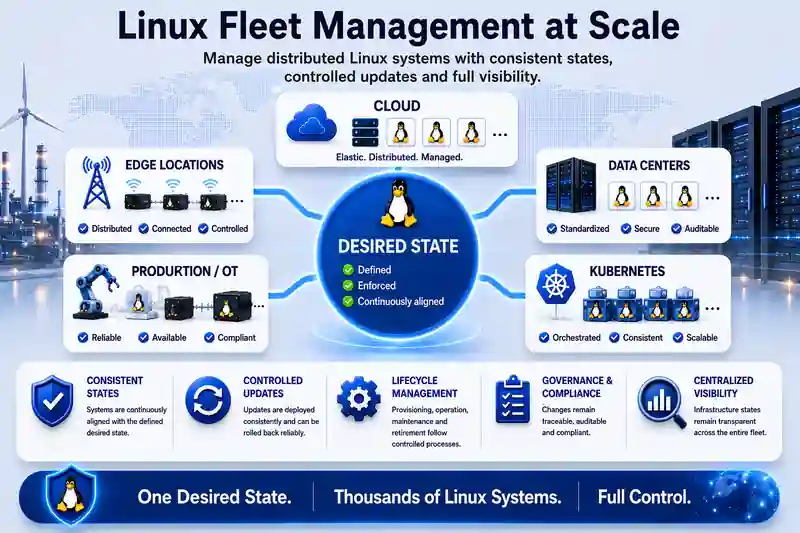
Modern IT/OT environments often consist of hundreds or thousands of Linux systems distributed across data centers, edge locations, production environments and cloud platforms.
As infrastructure grows, maintaining consistency becomes increasingly difficult. Different system versions, configuration drift and decentralized operations create operational complexity, increase update risks and reduce visibility into the actual state of the environment.
UPTR enables centralized management of distributed Linux fleets, automates Lifecycle processes and maintains controlled, reproducible and auditable infrastructure states throughout the entire infrastructure Lifecycle.
Without centralized control, systems and configurations gradually drift apart. As environments scale, operational complexity increases while visibility and control decrease.
UPTR provides a unified operational foundation for Linux fleet management. Through continuous desired state enforcement, controlled updates and centralized visibility, infrastructure remains consistent, traceable and manageable across edge, cloud and on-premise environments.
The Challenge
Linux systems form the foundation of many business-critical applications, platforms and operational environments.
As infrastructure expands, organizations face increasing challenges:
🔸 Different system versions across locations
🔸 Manual and difficult-to-track changes
🔸 Configuration drift between environments
🔸 Increasing update and maintenance effort
🔸 Limited visibility into actual system states
🔸 Security and compliance risks caused by inconsistent infrastructure
What starts as manageable system administration often evolves into a complex infrastructure landscape that becomes increasingly difficult to control.
Why Traditional Linux Management Reaches Its Limits
Traditional approaches often rely on manual processes, scripts and disconnected management tools.
This frequently results in:
🔸 Inconsistent configurations
🔸 Failed or incomplete updates
🔸 Uneven security postures
🔸 Extensive documentation effort
🔸 Difficult troubleshooting
🔸 Long recovery times
The larger the environment becomes, the harder it is to maintain a defined desired state across all systems.
What Modern Linux Fleet Management Requires
Effective Linux Fleet Management goes beyond system administration. It requires controlled infrastructure operations throughout the entire Lifecycle.
Key capabilities include:
🔹 Desired State Management
Systems are continuously aligned with a defined desired state.
🔹 Controlled Updates
Updates are deployed consistently and can be rolled back reliably when necessary.
🔹 Lifecycle Management
Provisioning, operation, maintenance and retirement follow controlled processes.
🔹 Governance and Compliance
Changes remain traceable and auditable.
🔹 Centralized Visibility
Infrastructure states remain transparent across the entire fleet.
How UPTR Supports Linux Fleet Management
UPTR combines Lifecycle Management, Desired State Enforcement and Immutable Infrastructure within a centralized Control Plane.
Organizations can:
➜ Manage Linux systems centrally
➜ Standardize infrastructure states
➜ Reduce configuration drift
➜ Deploy updates in a controlled manner
➜ Perform reliable rollbacks
➜ Support compliance requirements
➜ Operate edge, cloud and on-premise environments consistently
Instead of managing individual systems manually, UPTR enables scalable and reproducible operations across entire Linux fleets.
Typical Use Cases
👉 Distributed Edge Infrastructure
Managing large numbers of systems across geographically distributed locations.
👉 Production and OT Environments
Controlling infrastructure changes while maintaining high availability.
👉 Data Centers
Standardizing infrastructure states and automating lifecycle operations.
👉 Cloud and Hybrid Infrastructure
Maintaining governance and consistency across different operating models.
Benefits of UPTR
✔️ Reduced Configuration Drift
Systems remain aligned with their desired state.
✔️ Improved Operational Reliability
Controlled updates reduce operational risks.
✔️ Increased Visibility
Infrastructure states remain transparent and manageable.
✔️ Simplified Compliance
Traceable changes support audit and compliance requirements.
✔️ Scalable Operations
Large Linux fleets can be managed consistently and efficiently.