IT/OT Lifecycle Management
UPTR Control Plane is a software solution for centralized IT/OT Lifecycle Management and the centralized control of distributed IT/OT infrastructures.
It enables consistent, secure and controlled operations across IT and OT environments from System Provisioning to Decommissioning.
Without clear processes, complexity quickly turns into operational risk, making changes harder to manage and systems increasingly difficult to control over time.
The IT/OT Lifecycle defines the individual phases systems move through - from initial deployment to final decommissioning.
To understand how this Lifecycle works, it is essential to look at its structure and the role of each phase.
What is IT/OT Lifecycle Management

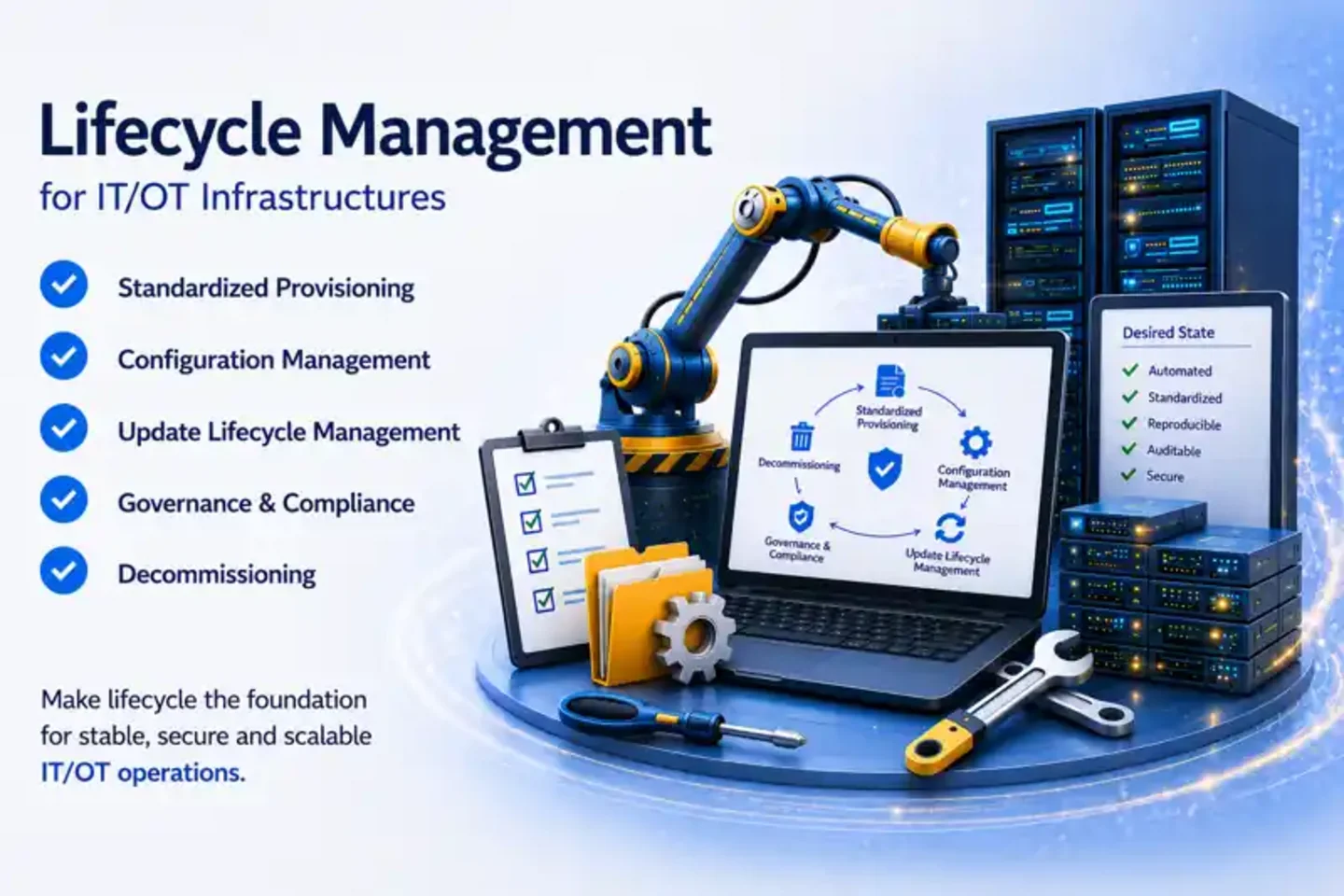
The IT/OT Lifecycle defines how systems are provisioned, configured, updated, governed and securely decommissioned throughout their entire Lifecycle - in a structured, controlled and reproducible way.
Instead of treating infrastructure as isolated and disconnected activities, the Lifecycle connects all operational phases into one continuous and consistent operating model.
In modern IT/OT environments, the Lifecycle is not a linear process but a continuous operational approach that ensures stable system states, controlled infrastructure changes and full visibility across distributed environments.
How the IT/OT Lifecycle works:
🔹 Provisioning: Deploy systems from standardized and reproducible baselines
🔹 Configuration Management: Continuously align systems with the defined desired state
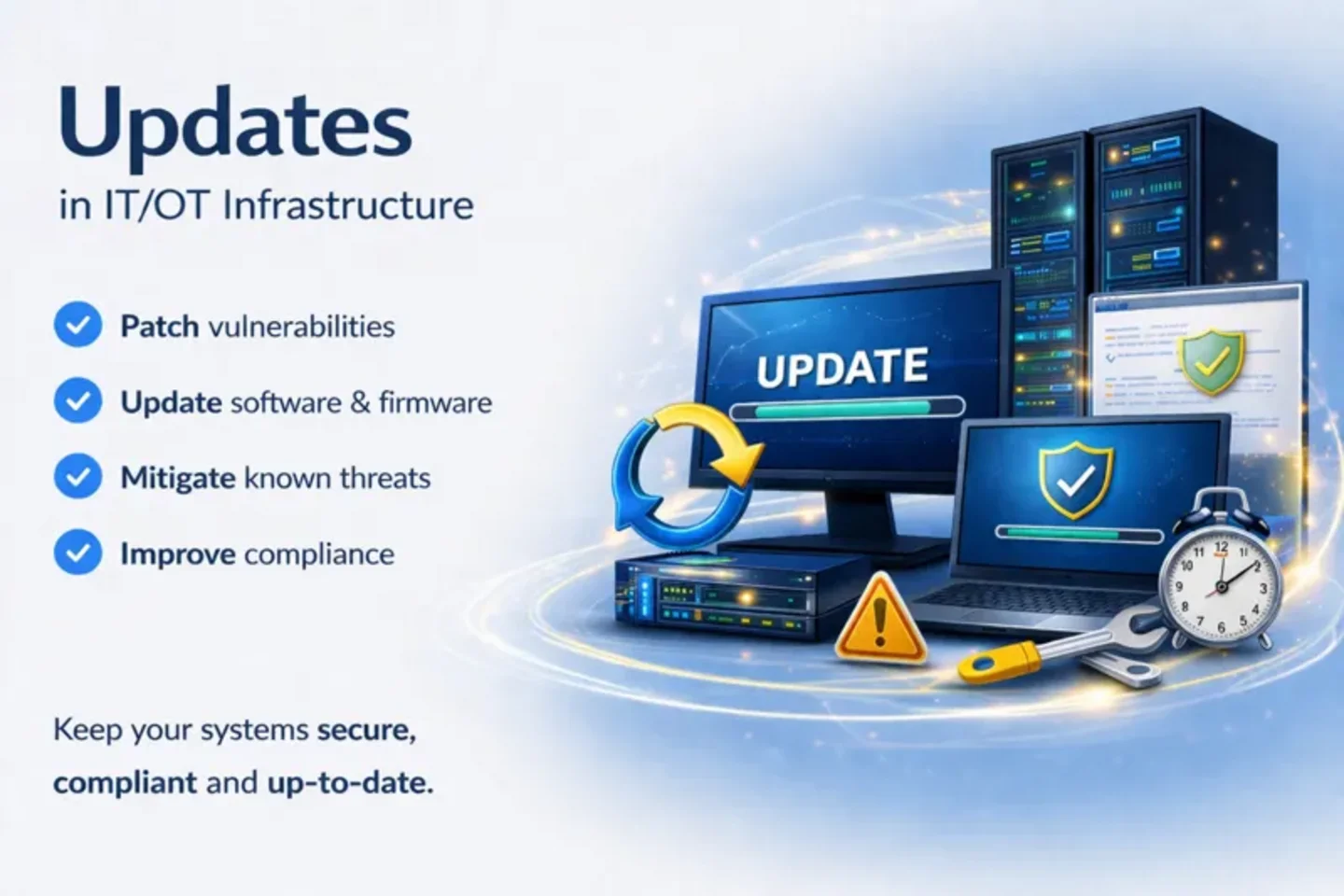
🔹 Update Lifecycle Management: Roll out infrastructure changes and updates in a controlled, traceable and testable way
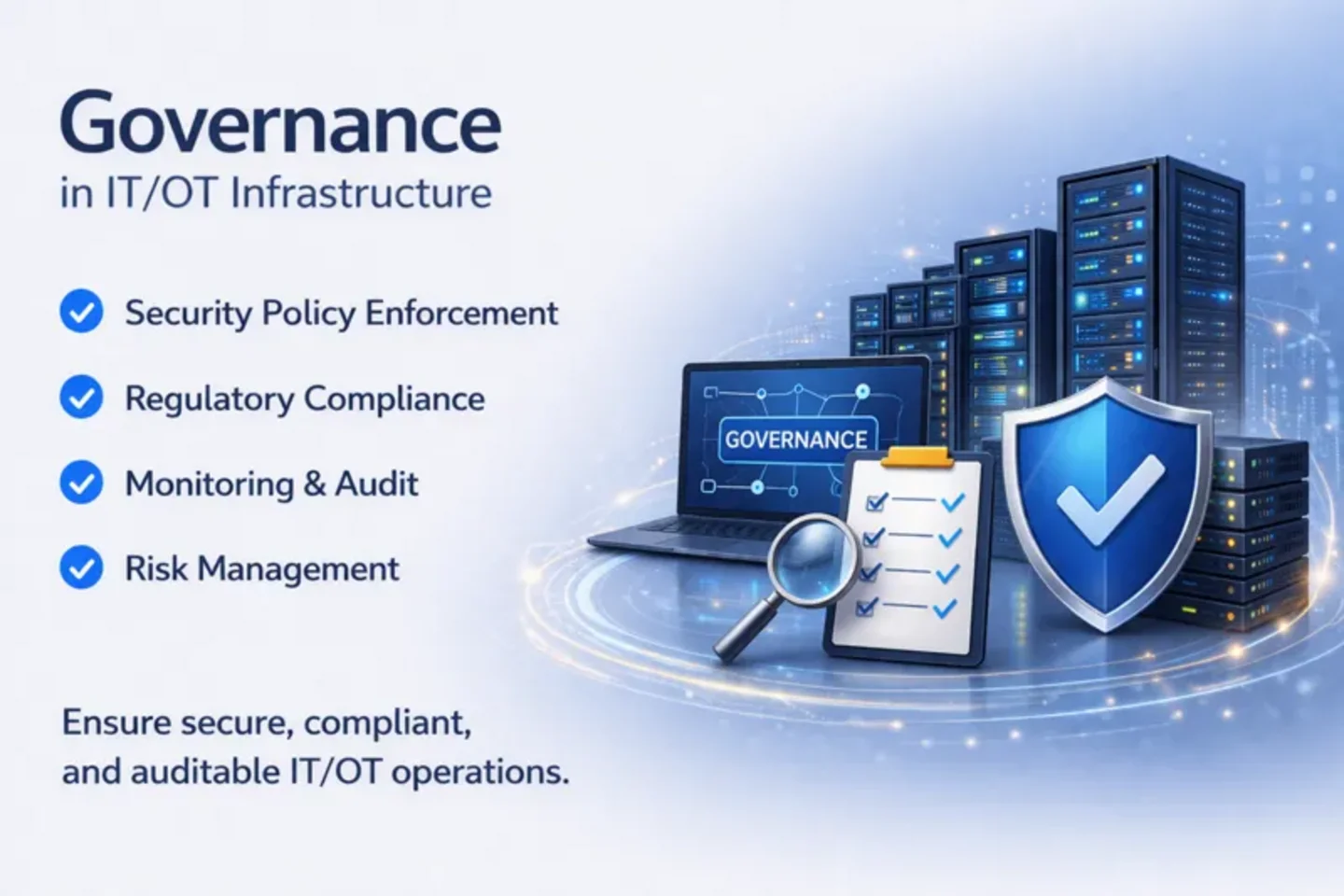
🔹 Governance & Compliance: Enforce security policies, governance and compliance consistently across all Lifecycle phases
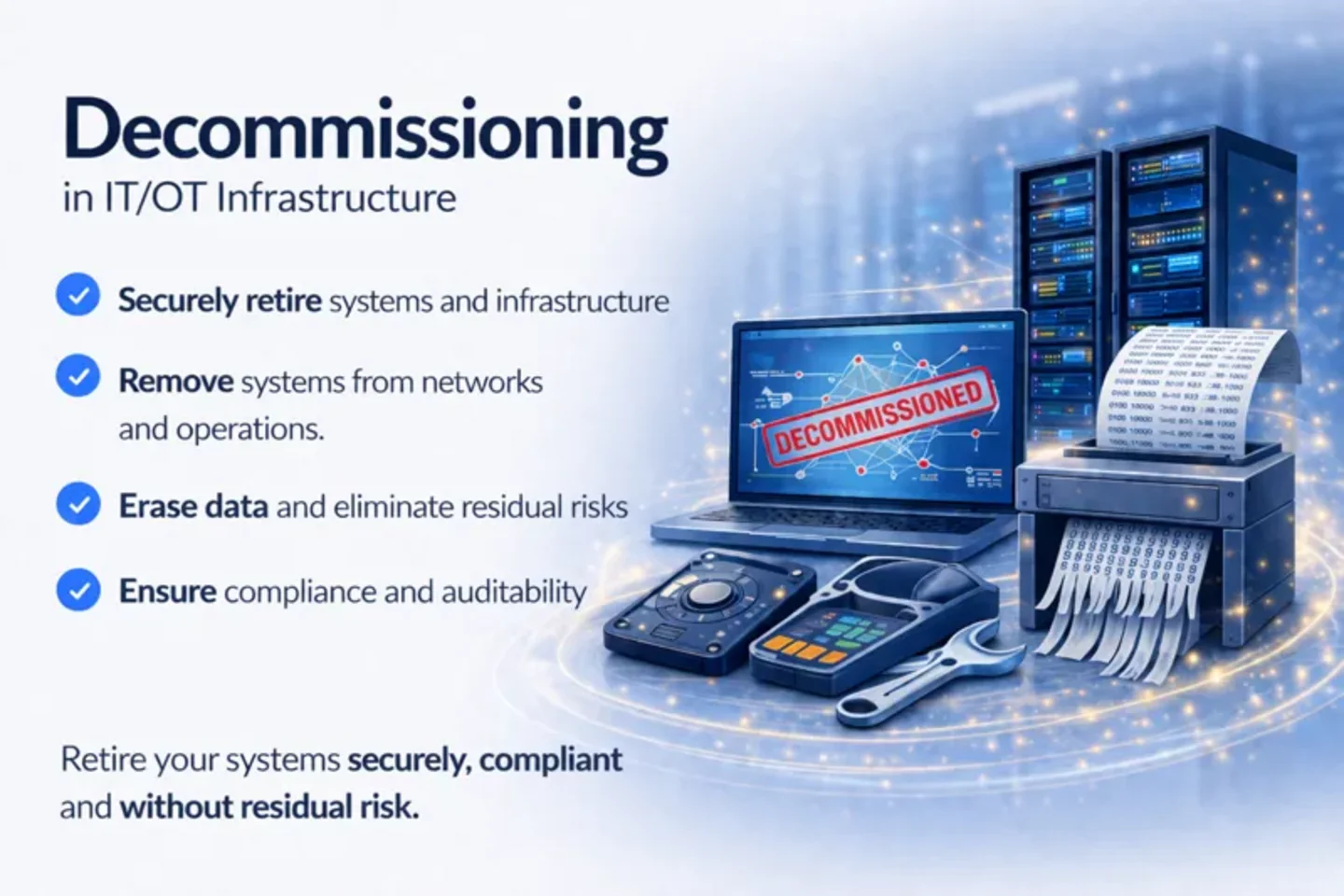
🔹 Decommissioning: Securely and verifiably remove systems from operation
In distributed IT/OT environments, this approach enables consistent operations across edge locations, industrial environments, data centers and cloud infrastructures.
A Lifecycle-driven approach reduces fragmentation and operational complexity across distributed environments.
Each phase of the IT/OT Lifecycle builds on the previous one - starting with System Provisioning, followed by Configuration Management, Update Lifecycle Management, Governance & Compliance and System Decommissioning.
The result is a controlled and Lifecycle-driven operating model for stable, secure and scalable IT/OT operations.
Why Lifecycle Management becomes critical in IT/OT environments
Modern IT/OT infrastructures are distributed across data centers, cloud platforms and edge locations. As complexity increases, maintaining consistency, security and control becomes significantly more challenging.
This leads to configuration drift, unpredictable behavior during updates and increasing operational risk.
Organizations operating industrial and critical infrastructure environments must meet strict operational requirements:
🔹 reliable over long operational periods
🔹 secure and compliant
Traditional IT operations were not designed for this level of stability and control. The Lifecycle approach addresses this gap by introducing a predictable operating model, where infrastructure is managed as a controlled system rather than a collection of manually maintained machines.
Automation plays a critical role in enabling this model. UPTR integrates Provisioning, Configuration, Updates, Governance and Decommissioning into a unified Lifecycle framework.
By automating these processes, infrastructure can be maintained in a consistent, transparent and reproducible state across all environments - particularly in distributed edge scenarios, where manual operations are no longer feasible.
Why Traditional Tools Fail
Traditional infrastructure and operations tools were typically designed for isolated tasks such as provisioning, configuration management, monitoring or updates. In modern IT/OT environments, this results in fragmented processes, inconsistent system states and a lack of end-to-end control across the entire Lifecycle.
As infrastructure becomes more distributed and interconnected, operational complexity increases significantly.
Typical consequences include:
🔹 inconsistent and drifting system states
🔹 manual and non-reproducible operations
🔹 uncontrolled updates and configuration drift
🔹 lack of traceability across the Lifecycle
🔹 high operational overhead in distributed environments
🔹 difficulties with governance, compliance and auditing
Without a Lifecycle-driven operating model, infrastructure remains a collection of isolated systems and tools - instead of a controlled, traceable and consistently managed operational environment.
The IT/OT Lifecycle as a Controlled System
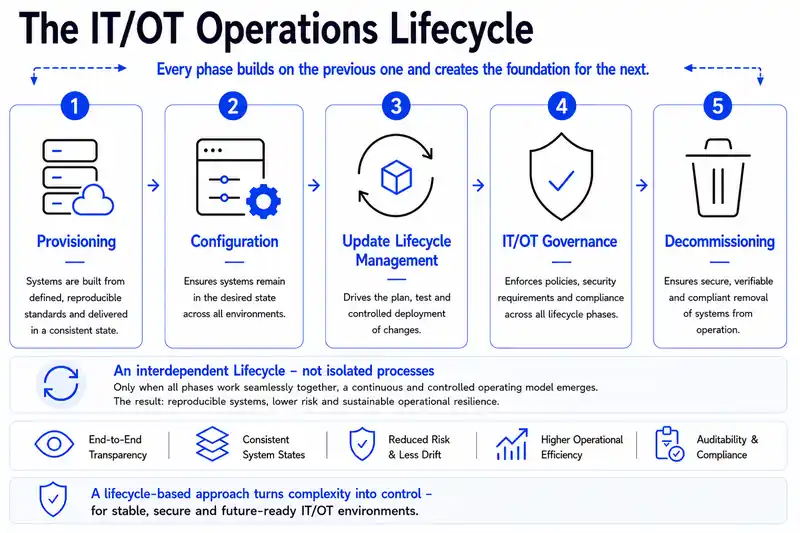
The IT/OT Lifecycle defines how infrastructure is managed from initial deployment to decommissioning. It provides a structured and controlled framework to ensure consistency, stability, and long-term operational control across all environments.
The Lifecycle operates as a connected system:
1. System Provisioning - deploys systems from a consistent, reproducible baseline
2. Configuration Management - maintains alignment with a defined desired state
3. Update Lifecycle Management - controls how changes are planned, tested and deployed
4. IT/OT Governance - enforces policies, security requirements and compliance
5. System Decommissioning - ensures systems are retired securely and systematically
IT/OT Governance applies across all phases, ensuring compliance and security, while System Decommissioning completes the Lifecycle in a controlled and traceable way.
A Lifecycle-driven approach transforms isolated infrastructure operations into a coordinated IT/OT Lifecycle.
1. System Provisioning
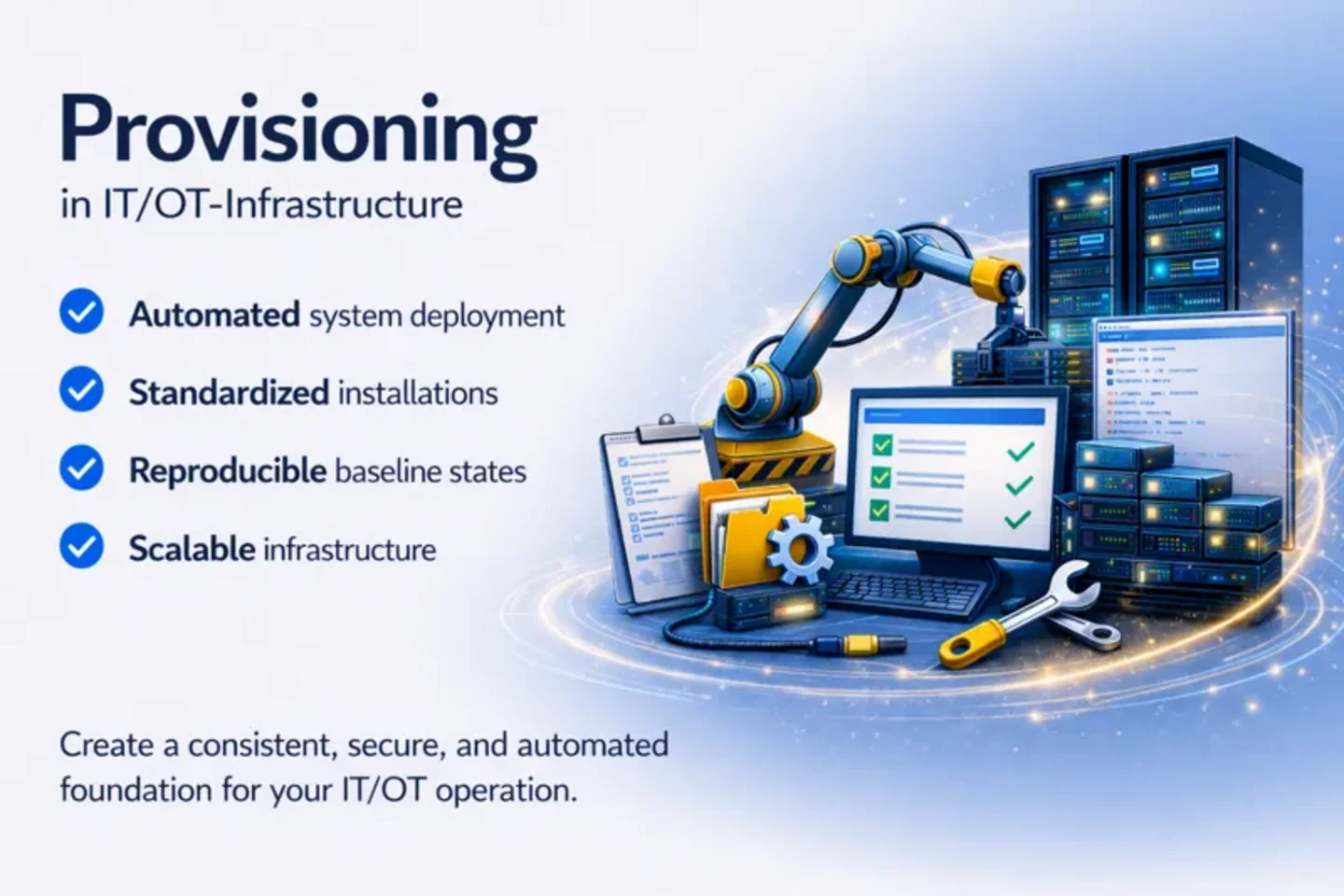
The IT/OT Lifecycle begins with reproducible System Provisioning. In industrial and edge environments, systems must often be deployed across hundreds of locations. Manual provisioning quickly becomes impractical and error-prone.
Automated Provisioning ensures systems start from a defined, reproducible baseline, including:
🔹 operating system installation
🔹 hardware initialization
🔹 network configuration
🔹 platform components
Modern provisioning mechanisms rely on image-based deployment and immutable operating systems, ensuring every node starts from the same trusted foundation (Immutable Infrastructure).
2. Configuration Management
Once systems are provisioned, infrastructure must be configured in a controlled and verifiable way.
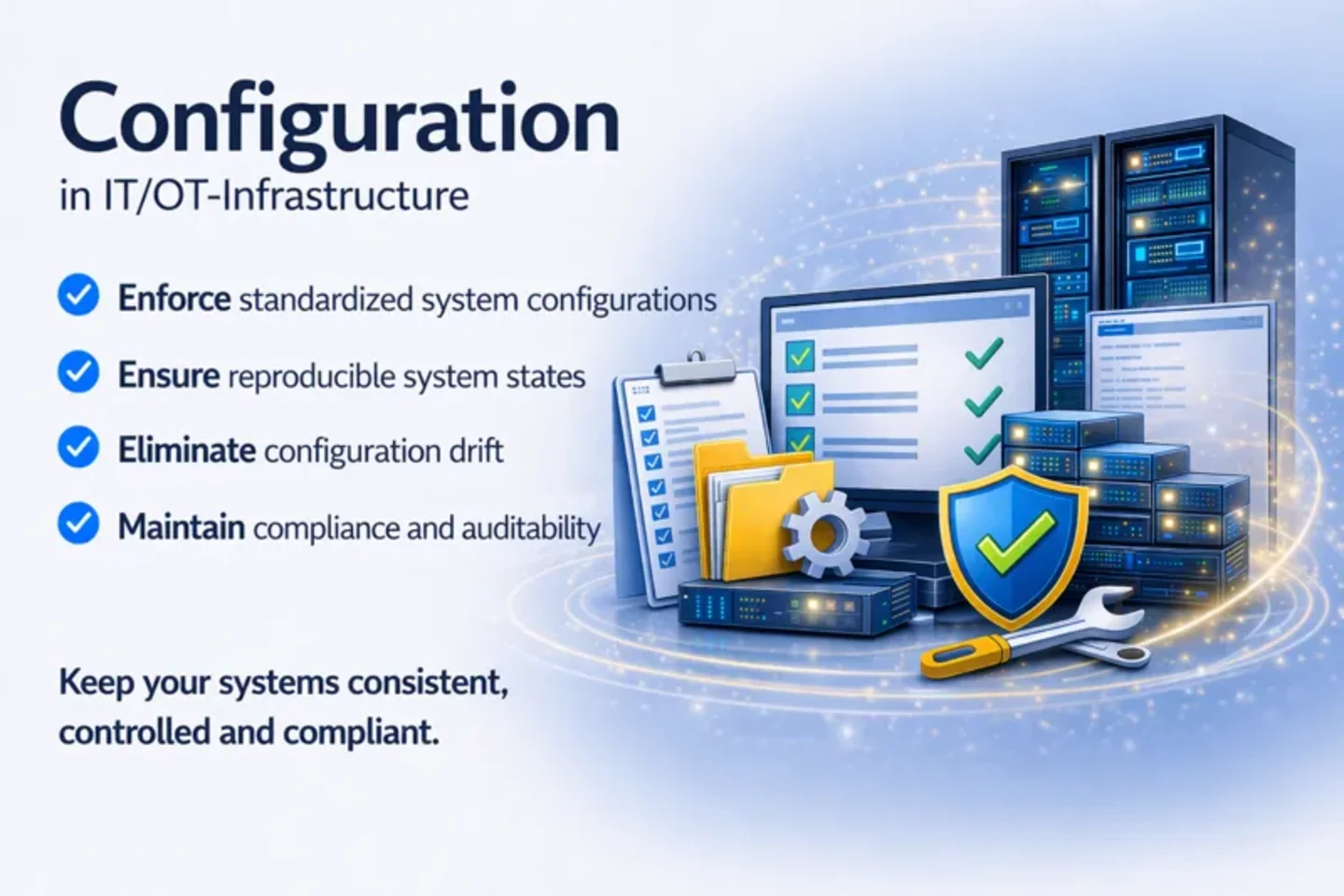
Configuration Management defines system roles, installed services, network parameters, security policies and workload behavior - ensuring that every system operates as intended.
Tools such as Ansible enable infrastructure to be managed as code, making configuration states versioned, auditable and automatically enforceable.
This eliminates configuration drift and allows systems to be rebuilt with deterministic and repeatable outcomes.
During daily operations, systems must remain stable and aligned with their defined state. This includes:
🔹 Monitoring infrastructure health
🔹 Scaling workloads
🔹 Managing distributed environments
🔹 Maintaining operational transparency
Without configuration control, infrastructure gradually moves out of alignment, until stability can no longer be guaranteed.
3. Update Lifecycle Management
One of the most critical phases of the IT/OT Lifecycle is Update Management. Updates are esp. necessary to implement security patches, feature improvements and compliance requirements.
However, updates can also introduce significant operational risk. Recent large-scale incidents have shown how a faulty update can disruptglobal IT systems within minutes.
A controlled Update Lifecycle includes:
🔹 staged rollouts
🔹 validation environments
🔹 automated deployment pipelines
🔹 rollback capabilities
4. IT/OT Governance
Infrastructure operations must comply with internal Governance rules and regulatory requirements (NIS2). This is especially relevant in sectors such as Energy, Transportation, Manufacturing, Logistics or Public Infrastructure.
Governance processes include:
🔹 configuration auditing
🔹 software approval processes
🔹 security policies
🔹 Compliance documentation
Lifecycle automation ensures that Governance rules are embedded directly into operational processes, rather than enforced manually.
5. Controlled Decommissioning
Safe and controlled System Decommissioning is essential to eliminate risks associated with legacy systems.
A structured and traceable decommissioning process includes removing dependencies, revoking access rights, and preserving relevant data and information required for compliance and audit purposes. This ensures that outdated systems are cleanly retired without leaving security gaps, uncontrolled components, or operational disruptions behind.
System Decommissioning is not the end of a system - it is a critical step in maintaining a secure, compliant, and resilient IT/OT environment.
Benefits of IT/OT Lifecycle Automation
A Lifecycle-driven approach improves operational consistency across provisioning, configuration, updates and governance. Structured Lifecycle processes reduce fragmentation and simplify infrastructure operations across distributed environments.
Infrastructure can be provisioned consistently across environments, reducing deviations from the beginning. Configuration Management keeps systems aligned with approved target states, preventing configuration drift and reducing manual intervention.
This results in measurable operational improvements:
✔️consistent deployments
✔️ traceable updates
✔️ reduced configuration drift
✔️ coordinated Lifecycle processes
Lifecycle processes remain coordinated across provisioning, configuration, updates and governance, helping organizations maintain consistent operational standards over time.
Overall, infrastructure becomes easier to manage - even in highly distributed IT/OT environments.
Result: Full Control Across the IT/OT Lifecycle
A Lifecycle-driven approach transforms infrastructure into a fully controlled system. Instead of managing isolated components, organizations operate infrastructure as an integrated and continuously governed Lifecycle.
This results in a fundamentally improved operating model:
✔️ end-to-end control across provisioning, configuration, updates and decommissioning
✔️ consistent system behavior across all environments
✔️ full transparency and traceability of all changes
✔️ predictable and controlled operations at scale
✔️ continuous compliance and security enforcement
Infrastructure is no longer reactive and fragmented, but defined in advance, automatically executed and continuously aligned with a desired state.
The result is a unified operational model: One Lifecycle. One Control Plane. Full Operational Control.
Use Cases of IT/OT Lifecycle Automation
Real-world IT/OT environments require scalable, reliable and controlled infrastructure operations. The following use cases illustrate how a Lifecycle-driven approach enables consistent and predictable operations across distributed environments.
Use Case: Edge Kubernetes Rollout
Moving applications to the edge is essential for reducing latency and enabling data-driven use cases. A Lifecycle-based approach ensures that all locations are deployed from a standardized state and centrally managed - enabling scalable edge infrastructure without loss of control.
Use Case: OT Gateway Migration
Legacy OT systems are critical for operations but difficult to modernize. A Lifecycle-driven model enables a structured, transparent and reversible transformation - allowing migration to modern edge services without production risk.
Use Case: BIOS to AI Lifecycle Automation
End-to-end control across all infrastructure layers is essential for integrating data into operations. A unified Lifecycle connects hardware, platform and applications into a single controllable system - ensuring stability, security and continuous innovation.
Use Case: Multi-site Industrial Deployment
Industrial growth increases the number of sites, systems and operational complexity. A Lifecycle-based approach enables standardized deployment and centralized control across all locations - making scaling predictable and manageable.
Key Challenges in IT/OT Lifecycle Management
Challenges in modern IT/OT environments rarely appear within a single phase of operations. They emerge across the entire Lifecycle - from Provisioning and Configuration Management to Updates and Decommissioning - creating dependencies that affect stability, security and operational efficiency.
Understanding these challenges is essential because they are often interconnected. Configuration inconsistencies influence updates, limited visibility affects security and compliance, and distributed environments increase operational complexity across systems and teams.
👉 Configuration Drift & Desired State
System states evolve over time through manual changes, exceptions and uncontrolled modifications. Without a defined target state, infrastructures gradually become unpredictable.
👉 Update Risks & Lifecycle Control
Updates often introduce operational risk when dependencies, versions and system states are not consistently controlled throughout the Lifecycle.
👉 Security, Compliance & Visibility
Modern environments require continuous visibility and traceability. Security and compliance challenges often emerge from inconsistent states rather than isolated incidents.
👉 Ownership & operational Complexity
As infrastructures grow, responsibilities are frequently distributed across multiple teams and technologies, creating unclear ownership and fragmented processes.
👉 Edge & Distributed Infrastructure
Distributed environments increase operational complexity because systems must remain consistent and manageable across different locations and environments.
Explore the IT/OT Lifecycle
Validate your IT/OT Lifecycle - before complexity becomes risk
Without Lifecycle control, every update becomes a potential system-wide outage.
Most organizations only recognize this risk after a failed update - when outages occur and recovery becomes complex, costly and time-critical.
Validate your Lifecycle now in a controlled environment - before complexity turns into operational risk.
Within 30 days, UPTR enables you to identify operational risks, validate your infrastructure setup and gain a clear, measurable decision framework - before issues turn into outages or security incidents.