Configuration Drift & Desired State
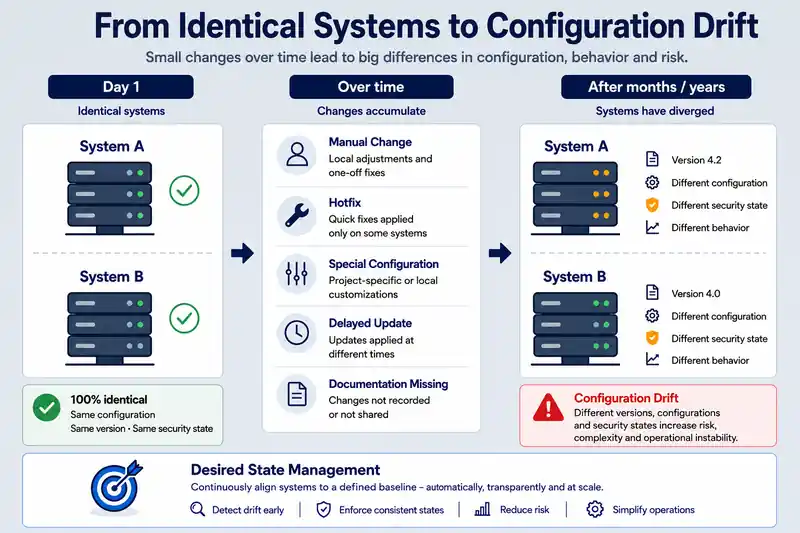
Infrastructure rarely fails because of a single change.
It fails because systems slowly drift away from the state they were originally designed to operate in.
Over time, configurations change.
Manual fixes accumulate. Updates are applied inconsistently across environments, sites and teams.
What starts as a small deviation eventually creates operational drift:
Different versions. Different behaviors. Different security states.
The problem is not only complexity.
The real problem is the loss of a reliable and reproducible system state.
Desired State Management changes this approach.
Instead of manually maintaining infrastructure over time, systems are continuously aligned against a defined baseline - automatically, transparently and at scale.
UPTR helps organizations detect configuration drift early, enforce consistent desired states and maintain stable IT/OT operations across the entire infrastructure Lifecycle.
Configuration Drift & Desired State Topics:
➜ Why systems drift over time without Lifecycle control (content in progress)
➜ How to prevent configuration drift in complex IT/OT environments (content in progress)
➜ How to maintain consistency across distributed environments and edge locations
➜ Why Immutable Infrastructure reduces operational drift and inconsistency
➜ Why controlled system states matter
➜ How to maintain a desired state across infrastructure Lifecycles (content in progress)
Strategic Perspective
Operational challenges rarely start as purely technical problems.
Growth, fragmented ownership and organizational decisions often create the conditions long before systems become unpredictable.
Read related APILANi insights.