Use Cases
Real-world IT/OT environments require scalable, reliable and controlled infrastructure operations.
The following Use Cases illustrate operational scenarios where distributed environments, Lifecycle complexity and changing system states create real challenges.
They show how UPTR establishes operational control and enables consistent, predictable and auditable Lifecycle operations.
Controlled Updates from BIOS to AI Workloads
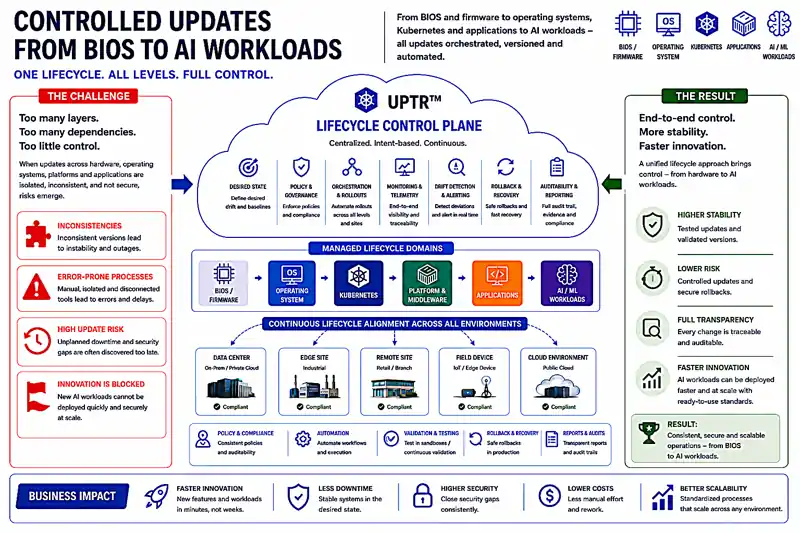
Modern IT/OT environments require continuous updates across the entire operational stack - from BIOS, firmware and operating systems to Kubernetes platforms, containers and AI workloads.
However, update processes are often fragmented across different tools, teams and infrastructure layers. Kubernetes can orchestrate application workloads, but it does not control the underlying infrastructure Lifecycle. As a result, organizations struggle with inconsistent update states, operational drift, security vulnerabilities and difficult rollback scenarios across distributed environments.
UPTR establishes a Lifecycle-driven Update model that restores operational control across the entire infrastructure stack. Systems are continuously aligned to approved and version-controlled states, while updates are centrally orchestrated, validated and governed throughout the complete IT/OT Lifecycle.
Kubernetes orchestrates applications and AI workloads, while UPTR controls the underlying infrastructure Lifecycle - including BIOS and firmware updates, operating system patching, configuration consistency, rollback strategies and operational governance.
This transforms updates from isolated technical tasks into a predictable, auditable and state-driven operational process. Infrastructure and workloads can be updated in a controlled and coordinated manner without introducing operational drift or uncontrolled risk, while all systems remain fully transparent and reproducible at all times.
The result: controlled updates from BIOS to AI workloads - with centralized Lifecycle control, predictable operations, consistent security and full auditability across all distributed IT/OT environments.
Modernizing OT Gateways and SCADA Operations
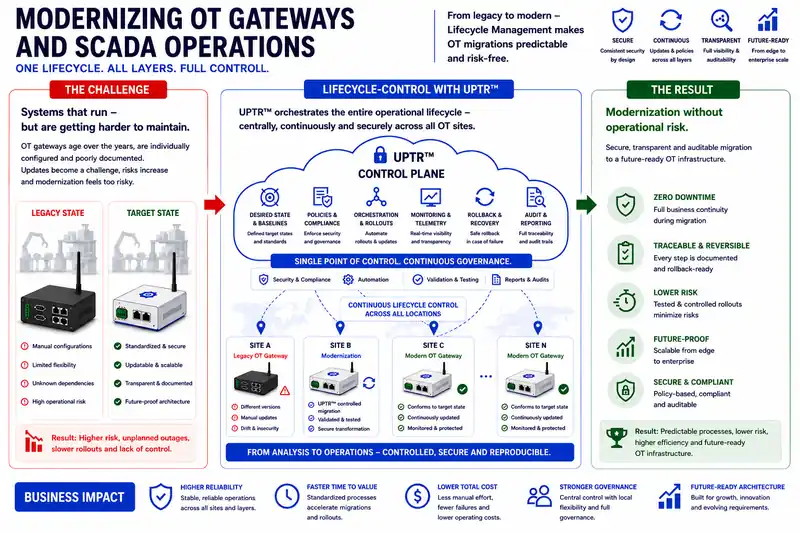
Many industrial and critical infrastructure environments still rely on legacy OT gateways and monolithic SCADA systems that were not designed for modern Lifecycle Management, distributed edge operations or cloud-native application platforms.
These environments are often operated through manual processes, isolated updates and inconsistent system states. As infrastructures grow and requirements for cybersecurity, compliance and operational resilience increase, traditional OT operations become increasingly difficult to scale, secure and govern.
UPTR introduces with Control Plane a Lifecycle-driven operational model that enables the controlled modernization of OT gateways and SCADA environments without introducing production risk. Systems are provisioned from standardized and version-controlled baselines, continuously aligned to a defined desired state and centrally orchestrated across the complete IT/OT Lifecycle.
Kubernetes enables the orchestration of modern edge applications, SCADA microservices and industrial workloads, while UPTR controls the underlying infrastructure Lifecycle - including provisioning, consistent configurations, updates, rollback strategies, certificates and operational governance.
This transforms OT modernization from isolated migration projects into a predictable, scalable and state-driven operational process. Legacy environments can be modernized incrementally without uncontrolled downtime, while all systems remain fully transparent, reproducible and auditable throughout the transition.
The result: modernized OT gateways and SCADA operations - with centralized Lifecycle control, predictable operations, consistent security and full transparency across distributed industrial environments.
AI/ML Operations on Industrial Edge Infrastructure
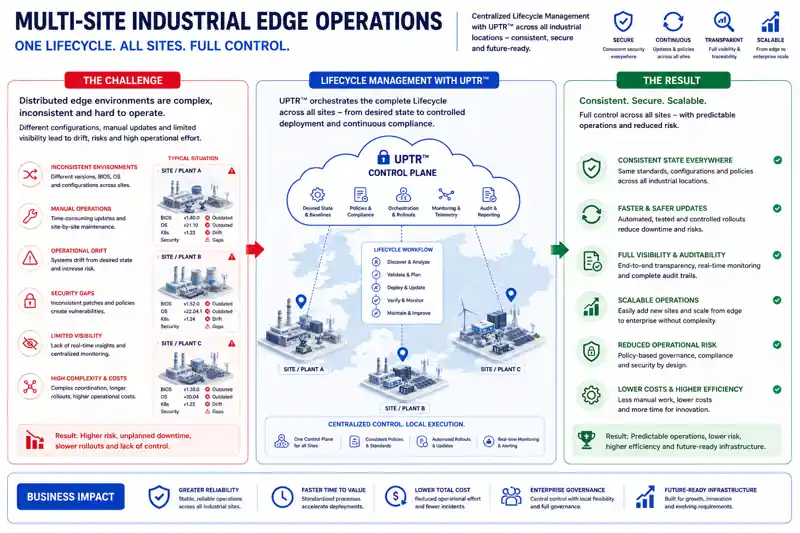
Industrial AI and machine learning workloads require more than scalable compute resources. They depend on a controlled, reproducible and continuously managed infrastructure foundation across distributed edge environments.
However, many organizations operate fragmented AI infrastructures with inconsistent GPU configurations, manually prepared systems, isolated update processes and limited operational transparency. As AI workloads move closer to production and operational processes, uncontrolled infrastructure states increasingly become a risk for stability, security and scalability.
UPTR establishes a Lifecycle-driven operational model that enables controlled AI/ML operations across industrial edge infrastructures. Systems are provisioned from standardized and version-controlled baselines, continuously aligned to a defined desired state and centrally orchestrated throughout the complete IT/OT Lifecycle.
Kubernetes orchestrates AI/ML workloads, inference services and distributed applications, while UPTR controls the underlying infrastructure Lifecycle - including <a GPU and edge provisioning, operating system and driver consistency, AI platform baselines, updates, rollback strategies and operational governance.
This transforms AI infrastructure operations from isolated deployment projects into a predictable, scalable and state-driven operating model. AI workloads can be deployed, updated and scaled consistently across distributed industrial environments without introducing operational drift or uncontrolled risk.
The result: controlled AI/ML operations on industrial edge infrastructure - with centralized Lifecycle control, predictable operations, consistent security and full transparency across all distributed AI environments.
Real-world IT/OT operations require controlled Lifecycle Management
From Kubernetes baselines and edge rollouts to OT modernization and controlled updates, UPTR transforms fragmented infrastructure processes into reproducible, centrally governed and Lifecycle-driven operations - enabling predictable, scalable and audit-ready IT/OT environments before complexity becomes operational risk.