Ownership & Operational Complexity
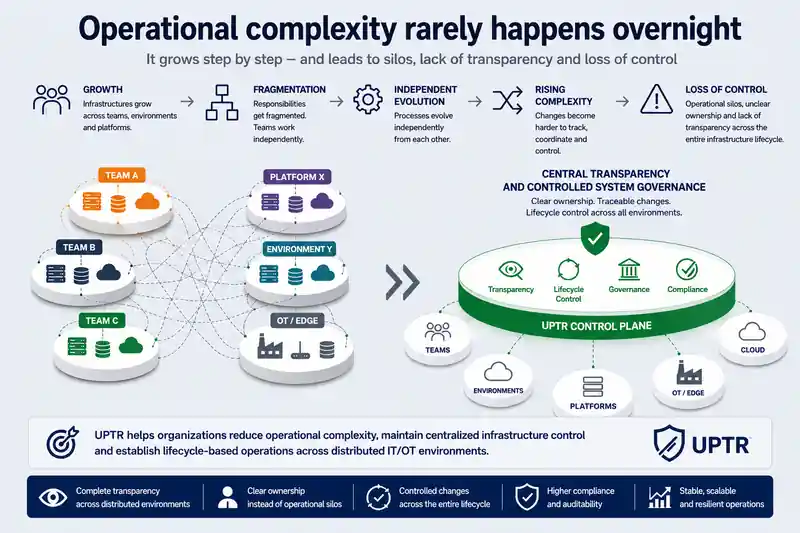
Operational complexity rarely appears all at once.
It grows gradually as infrastructures expand across teams, environments, platforms and operational domains.
Over time, responsibilities become fragmented.
Different teams manage different parts of the infrastructure.
Processes evolve independently.
Changes become harder to track, coordinate and control consistently.
What initially looks manageable eventually creates operational silos, unclear ownership and increasing loss of control across the infrastructure Lifecycle.
The problem is not only technical complexity.
The real problem is the absence of centralized operational visibility and controlled system governance across distributed environments.
Without clear ownership structures, traceable system changes and centralized Lifecycle control, organizations struggle to maintain consistency, accountability and operational stability at scale.
UPTR helps organizations reduce operational complexity, maintain centralized infrastructure control and establish Lifecycle-driven operations across distributed IT/OT environments.
Ownership & Operational Complexity Topics:
➜ Why ownership becomes fragmented (content in progress)
➜ Why nobody owns the whole system (content in progress)
➜ How to reduce operational complexity (content in progress)
➜ How to maintain control over system changes
➜ How to maintain centralized control across distributed infrastructure
Strategic Perspective
Operational challenges rarely start as purely technical problems.
Growth, fragmented ownership and organizational decisions often create the conditions long before systems become unpredictable. Read related APILANi insights.