Controlled bootc
Traditional infrastructure operations struggle to control change across distributed IT/OT environments.
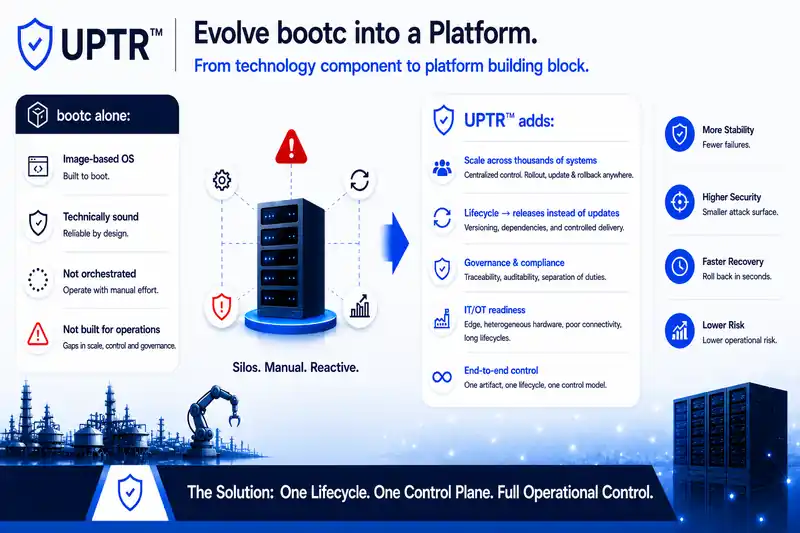
UPTR extends bootc from an image-based technology component into a controlled operational platform with Lifecycle Control, Governance and reproducible system states.
From Image to Control
The concept behind bootc represents a fundamental shift:
Instead of installing and patching individual packages, the entire operating system is built, distributed and run as a versioned, container-like system image. This creates consistency and enables reproducibility.
But it does not yet solve the real challenge:
How do you operate these systems reliably, with control and at scale?
A technically sound system image does not automatically translate into a controlled, manageable operation.
bootc defines how a modern operating system is built. UPTR defines how it works in the real world.
Only through this interplay does an image-based approach become a fully controlled operational platform:
➜ bootc evolves from a technical concept into a scalable platform building block
➜ Updates become controlled releases instead of operational risks
➜ Governance and compliance become integral to operations
➜ Cloud-native principles extend into real IT/OT environments and the edge
UPTR Control Plane makes bootc usable where it actually matters - in secure, scalable, and auditable operations.
How Images Become Controlled Systems
1. From Image to Platform at Scale
bootc delivers a solid, image-based OS, but without orchestration.
UPTR Control Plane adds:
➜ Centralized control across thousands of systems
➜ Coordinated rollout, update, and rollback strategies
➜ A unified operating model across cloud, data center, and edge
Result: Through UPTR Control Plane, bootc evolves from a technology component into a platform building block.
2. Lifecycle instead of ad-hoc Updates
bootc focuses on building and booting the OS.
UPTR extends this into a controlled Lifecycle:
➜ Versioning and staged releases (dev - stage - prod)
➜ Dependency management across OS, platform, and services
➜ Controlled, predictable updates
Result: Through UPTR Control Plane, Updates are no longer events - they become releases.
3. Governance and Compliance by Design
bootc provides reproducibility, but not operational governance.
UPTR Control Plane ensures:
➜ Full traceability (who, when, where, which version)
➜ Separation of duties between security and operations
➜ Auditability across the entire Lifecycle
Critical for: regulated industries, critical infrastructure and public sector environments.
4. Bridging Cloud-Native and IT/OT Reality
bootc is designed for cloud-native environments.
UPTR Control Plane makes it work in the real world:
➜ Edge locations with unreliable connectivity
➜ Heterogeneous hardware landscapes
➜ Long system Lifecycles
➜ High availability requirements
Result: Through UPTR Control Plane, bootc operates reliably where traditional cloud tools reach their limits.
5. End-to-End Control instead of Fragmentation
Without orchestration, the OS remains a separate concern.
UPTR provides:
➜ One Artifact
➜ One Lifecycle
➜ One Control Model
From code - to OS - to operations
Result: No more special treatment for the operating system.
Key Takeaway
Cloud-native doesn't end with containers - it begins with the OS.
UPTR Control Plane turns bootc into what enterprises actually need:
a controllable, auditable and scalable operational platform.
Extend bootc into a controlled operational platform
bootc creates consistent and reproducible system images.
UPTR extends bootc beyond image-based operating systems by enabling controlled rollouts, Lifecycle Governance and reproducible operations across distributed IT/OT environments.