Update Risks & Lifecycle Control
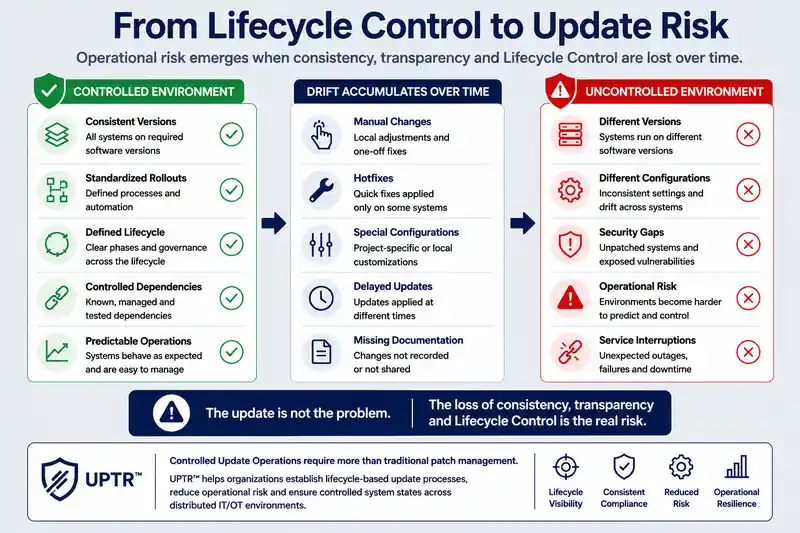
Updates rarely become dangerous because of a single deployment.
The real risk emerges when infrastructures lose consistency, visibility and Lifecycle control over time.
Different software versions, inconsistent rollout processes, manual interventions and uncontrolled dependencies gradually create environments that become harder to predict and increasingly difficult to operate safely.
What once looked like a routine update process eventually turns into operational risk:
Unexpected failures. Service disruptions. Security gaps. Inconsistent system states.
The problem is not only the update itself.
The real problem is the lack of controlled and reproducible infrastructure states throughout the Update Lifecycle.
Controlled update operations require more than patch management alone.
UPTR helps organizations maintain Lifecycle-driven update processes, reduce operational risk and enforce controlled system states across distributed IT/OT environments.
Update Risk & Lifecycle Control Topics:
➜ Why updates become unpredictable (content in progress)
➜ Why updates become an operational risk
➜ Why updates suddenly fail (content in progress)
➜ Why updates become a systemic risk in complex and critical IT/OT environments (KRITIS)
➜ How to reduce update risk (content in progress)
➜ How to maintain controlled updates (content in progress)
Strategic Perspective
Operational challenges rarely start as purely technical problems.
Growth, fragmented ownership and organizational decisions often create the conditions long before systems become unpredictable.
Read related APILANi insights.