Kubernetes Lifecycle Management
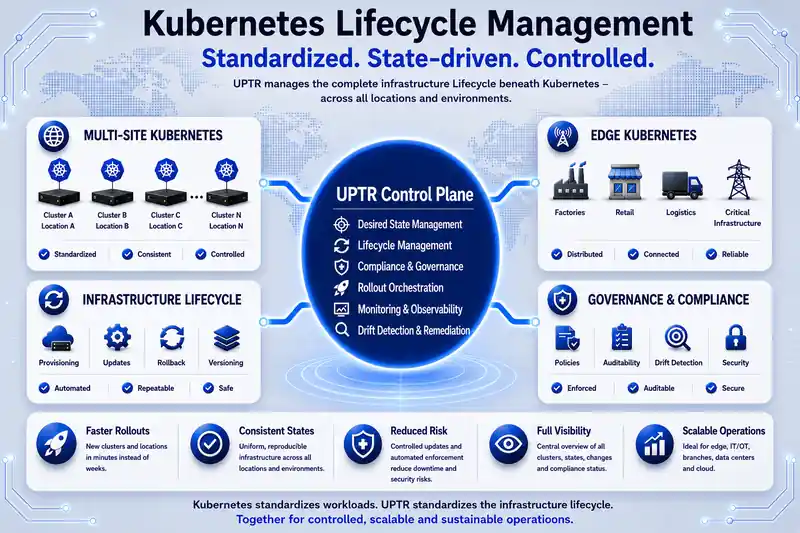
Kubernetes Lifecycle Management requires more than Kubernetes.
Kubernetes standardizes the orchestration of containers and applications. However, much of the operational complexity exists below the Kubernetes layer: operating systems, infrastructure, edge environments, cluster provisioning, updates, compliance requirements and maintaining control across distributed environments.
As the number of clusters, locations, and platforms grows, so does operational complexity. Configuration inconsistencies, manual processes and uncontrolled changes often lead to drift, security risks, and a loss of operational visibility.
Modern Kubernetes Lifecycle Management therefore extends beyond workload orchestration. It covers the entire Infrastructure Lifecycle - from provisioning and rollouts to updates, rollbacks, governance, compliance and continuous state control.
Only by managing infrastructure and Kubernetes as a unified operational platform can organizations achieve standardized, reproducible and scalable operations across all environments.
The Challenge
Kubernetes has fundamentally simplified the deployment and operation of applications. The real challenge begins when Kubernetes must be operated at scale across multiple environments.
With every additional cluster, location, or edge deployment, the requirements for standardization, governance, and lifecycle control increase.
In many organizations, infrastructure components, operating systems, cluster configurations, and update processes are still managed separately. Over time, this creates inconsistent platform states, fragmented operations, and growing administrative overhead.
Changes require increasing coordination. Updates become more difficult to standardize. Visibility into actual system states and deviations gradually decreases.
The result is higher operational risk, slower rollouts, and increasing effort to maintain stability, security, and compliance across the entire Kubernetes landscape.
The UPTR Approach
UPTR provides a centralized Control Plane that manages the complete infrastructure Lifecycle beneath Kubernetes.
Desired States are defined once and automatically enforced across all locations and environments.
UPTR continuously manages:
➜ Infrastructure Provisioning
➜ Operating system Lifecycle Management
➜ Platform standardization
➜ Policy enforcement
➜ Compliance controls
➜ Update orchestration
➜ Drift detection and remediation
Kubernetes continues to manage containerized workloads while UPTR ensures that every cluster operates on a controlled, reproducible and compliant infrastructure foundation.
The Result
Organizations gain a standardized operating model for Kubernetes environments across all locations.
Benefits include:
✔️ Faster cluster rollouts
✔️ Consistent infrastructure states
✔️ Reduced operational effort
✔️ Lower update and change risks
✔️ Improved security and compliance
✔️ Full visibility into infrastructure states
✔️ Scalable multi-site and edge operations
This approach is particularly valuable for organizations operating Kubernetes across manufacturing and industrial IT/OT environments, retail and branch networks, logistics and distribution centers, critical infrastructure environments and distributed edge locations.
Where Kubernetes Lifecycle Management Creates Value
👉 Multi-Site Kubernetes Operations
Operate Kubernetes consistently across multiple data centers, cloud environments and regional locations. UPTR maintains standardized infrastructure states and centralized lifecycle control across all clusters.
👉 Edge Kubernetes Operations
Deploy Kubernetes reliably across manufacturing sites, logistics hubs, retail locations and distributed edge environments. UPTR ensures consistent provisioning, updates and governance at scale.
👉 Standardized Infrastructure Foundation
Establish a reproducible infrastructure baseline for Kubernetes environments. UPTR controls provisioning, operating system lifecycles, updates and desired state enforcement across all locations.
👉 Governance & Compliance
Maintain auditability, policy enforcement and operational transparency throughout the infrastructure lifecycle while reducing operational risk.
Key Takeaway
Kubernetes standardizes workloads.
UPTR standardizes the infrastructure Lifecycle beneath Kubernetes.
Together they enable controlled, scalable and compliant operations across distributed environments.