UPTR Control Plane
UPTR Control Plane is a software solution for centralized IT/OT Lifecycle Management and the centralized control of distributed IT/OT infrastructures.
It serves as the central architecture layer for state-driven IT/OT operations.
UPTR continuously aligns infrastructure with a defined desired state and manages Lifecycle workflows across Provisioning, Configuration, Updates, Governance and Decommissioning - enabling controlled, transparent and auditable operations across Edge, Data Center and Cloud environments.
Why Modern Infrastructure Models Gradually Lose Control
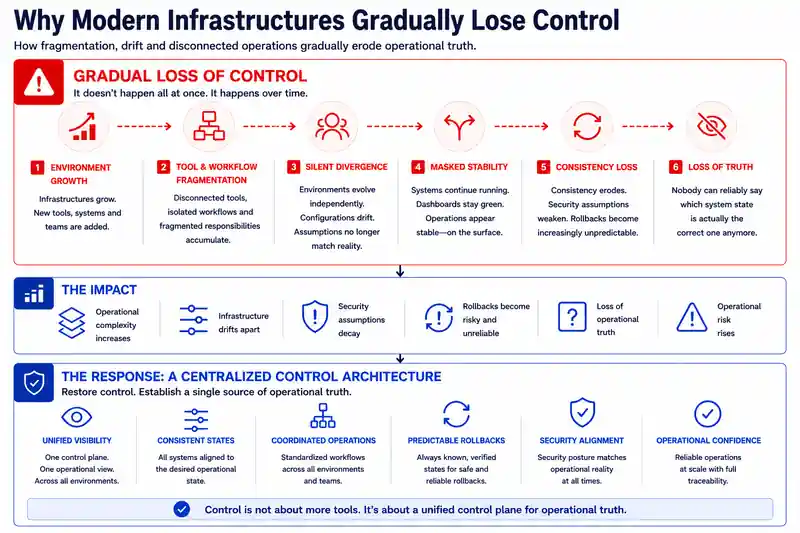
Modern IT/OT infrastructures rarely lose control all at once.
The loss of control usually begins slowly and almost invisibly. Traditional infrastructure models were never designed to continuously maintain operational consistency across highly distributed and rapidly changing environments.
As infrastructures grow, organizations accumulate disconnected automation tools, isolated workflows and fragmented operational responsibilities. Different environments evolve independently over time, configurations drift apart and operational assumptions no longer fully match the actual state of systems.
Initially, operations still appear stable. Systems continue running and monitoring dashboards remain green.
But beneath the surface, infrastructure slowly loses consistency. Security assumptions become less reliable, rollbacks grow increasingly unpredictable and at some point nobody can confidently say which system state is actually the correct one anymore.
This is where operational instability begins, and why modern operations increasingly require a centralized control architecture instead of isolated operational tooling.
Control Across Fragmented IT/OT Environments
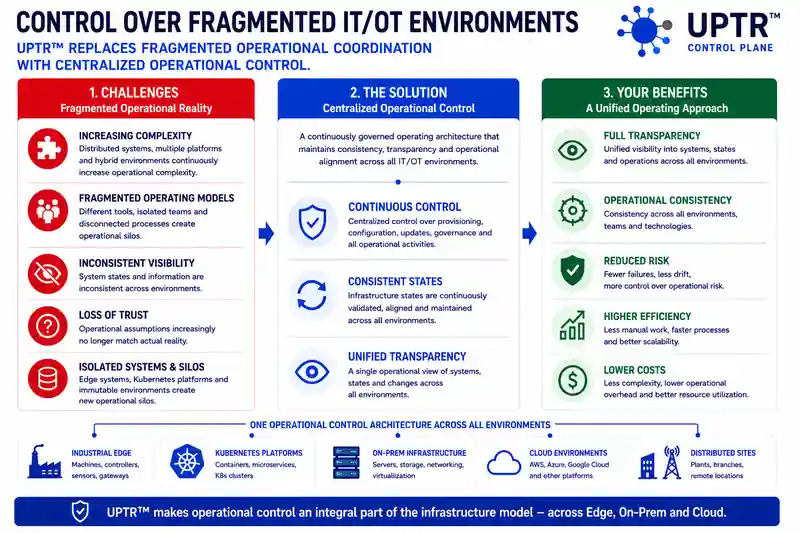
Modern infrastructures rarely operate within a single centralized environment anymore. Industrial Edge systems, Kubernetes platforms, hybrid infrastructures and distributed operational sites continuously increase operational complexity across the entire IT/OT landscape.
At the same time, traditional operations often evolve into fragmented operational structures. Different tools manage different parts of the infrastructure. Teams operate independently. Visibility becomes inconsistent across environments. Over time, organizations lose confidence in whether operational assumptions still match operational reality.
UPTR replaces fragmented operational coordination with centralized operational control across distributed IT/OT environments.
Instead of manually coordinating disconnected operational processes, organizations establish a continuously governed operational architecture where consistency, visibility and operational alignment are maintained across the entire infrastructure landscape.
Industrial systems and remote Edge locations can be operated through the same operational model as centralized infrastructure environments. Kubernetes platforms become part of the same operational control architecture instead of introducing additional operational silos.
Image-based and immutable systems such as bootc environments can be integrated into a continuously governed operational model where updates become controlled operational releases instead of isolated technical events.
Operational control no longer depends on tribal knowledge or isolated operational expertise. It becomes part of the infrastructure model itself.
This creates one operational control architecture across Edge, On-Prem and Cloud environments.
One Desired State. One Operational Truth.
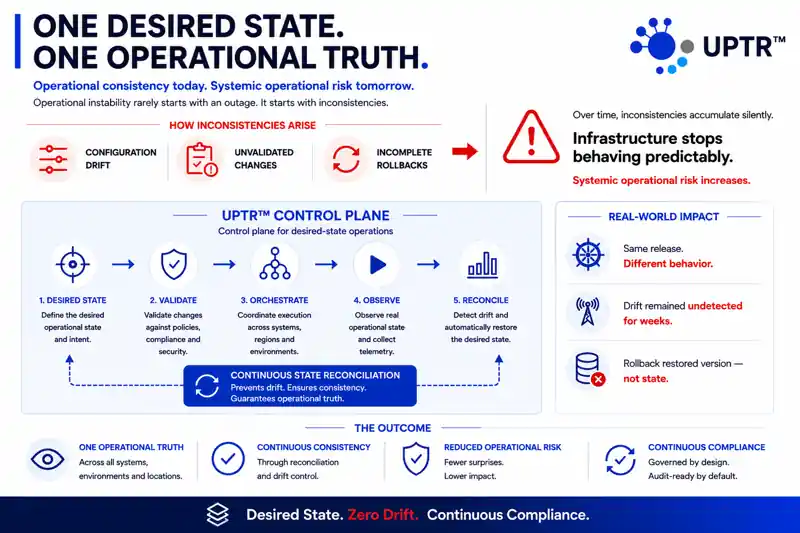
Operational instability rarely starts with a visible outage. It usually begins much earlier.
A small configuration difference between environments. An unvalidated operational change. A dependency that behaves differently in production than expected. A rollback that restores the application version - but not the underlying infrastructure state completely.
Over time, these inconsistencies accumulate silently. At some point, infrastructure stops behaving predictably. This is why operational consistency has become one of the most critical requirements of modern infrastructure operations.
UPTR operates infrastructure through centrally defined and continuously reconciled system states. Instead of treating provisioning, configuration and updates as isolated operational activities, UPTR establishes one continuously aligned operational model across the entire infrastructure landscape.
The desired operational state becomes the central operational reference point for rollouts, validations and infrastructure decisions. Every configuration, dependency, policy and operational baseline is continuously validated against this operational truth.
The UPTR Control Plane coordinates this process across systems, environments and operational domains. Operational drift is continuously detected and corrected before hidden inconsistencies evolve into systemic operational risk.
This becomes especially important in modern distributed infrastructures where Edge environments, hybrid platforms and Kubernetes-based systems must remain operationally aligned across multiple locations and infrastructure layers.
Typical operational inconsistencies may include:
🔸 A Kubernetes environment behaves differently than the staging platform although both are supposed to run the same release.
🔸 A remote Edge site continues operating with outdated configuration policies because operational drift remained undetected for weeks.
🔸 An operational rollback restores the application version while underlying infrastructure dependencies remain inconsistent.
🔸 Infrastructure changes are applied successfully in one environment but behave differently in production operations.
🔸 Distributed operational sites slowly diverge from the originally validated infrastructure baseline.
These situations rarely appear critical at first - but over time they gradually erode operational reliability, transparency and trust across the entire infrastructure landscape.
Changes are orchestrated centrally. Infrastructure states remain continuously observable, validated and aligned.
This transforms infrastructure operations from reactive system management into a controlled and continuously governed operational model.
Architecture of UPTR
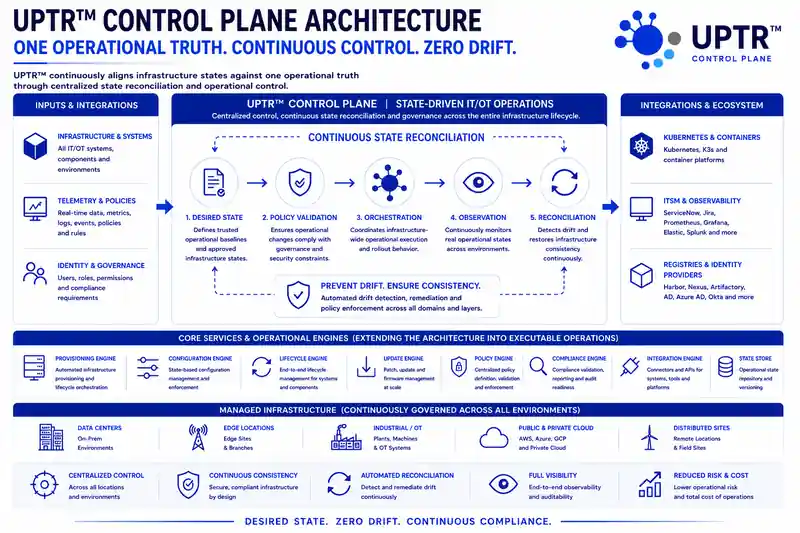
Instead of managing infrastructure through isolated operational processes, UPTR continuously aligns systems against one defined operational truth.
Infrastructure states are continuously validated, observed and reconciled across environments, operational domains and infrastructure layers. This allows infrastructure operations to remain predictable, consistent and operationally aligned even in distributed IT/OT environments.
Operational changes, infrastructure policies and rollout behaviors remain continuously coordinated through centralized operational control. Hidden operational drift can therefore be detected and corrected before inconsistencies evolve into operational instability or systemic infrastructure risk.
At the same time, the architecture establishes an operational control model where infrastructure states are not only provisioned, but continuously monitored, validated and kept operationally aligned over time. Infrastructure operations therefore evolve from isolated administrative activities into a continuously governed operational system.
At the center of this architecture is the UPTR Control Plane, providing a continuously controlled operating model for state-driven IT/OT lifecycle management based on five core operational mechanisms:
🔹 Desired State ➜ Defines trusted operational baselines and approved infrastructure states.
🔹 Policy Validation ➜ Ensures operational changes comply with governance and security constraints.
🔹 Orchestration ➜ Coordinates infrastructure-wide operational execution and rollout behavior.
🔹 Observation ➜ Continuously monitors real operational states across environments.
🔹 Reconciliation ➜ Detects operational drift and restores infrastructure consistency continuously.
Together, these operational mechanisms establish the foundation for continuously governed infrastructure operations across Edge, On-Prem and Cloud environments.
The following Core Services and Operational Engines implement the operational capabilities of the UPTR Control Plane and continuously maintain the desired system state throughout the entire IT/OT Lifecycle.
Core Services & Operational Engines of the UPTR Control Plane
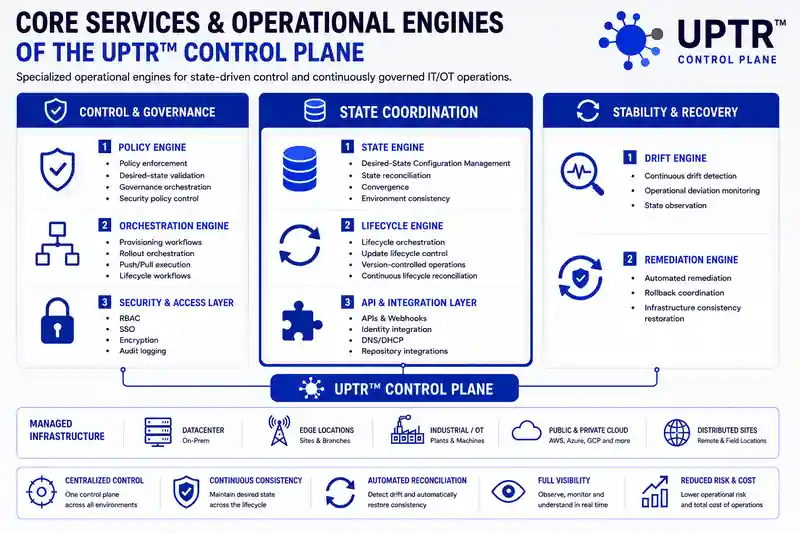
The UPTR Control Plane combines specialized operational engines to continuously control Provisioning, Configuration Management, Update orchestration, Governance and Lifecycle consistency across distributed IT/OT infrastructures.
Controlled IT/OT Lifecycle Management does not happen automatically.
It requires dedicated operational services that continuously validate infrastructure states, orchestrate changes, detect drift, enforce policies and restore operational consistency across all environments.
Operational activities therefore no longer remain isolated technical tasks executed independently across teams and systems. Instead, they become continuously coordinated operational processes governed through centralized control, state awareness and infrastructure-wide policy enforcement.
To establish this operational model, the UPTR Control Plane organizes its operational engines into three functional control domains: Control & Governance, State Coordination, and Stability & Recovery. These domains reflect how infrastructure operations actually behave in practice - operational decisions must first be governed, infrastructure states must remain continuously coordinated, and operational deviations must be detected and corrected before they evolve into systemic infrastructure risk.
Together, these operational domains establish a continuously governed control architecture where infrastructure operations remain predictable, observable and operationally aligned across the entire Lifecycle.
This is exactly how the UPTR Control Plane closes the Lifecycle loop.
Infrastructure operations evolve from disconnected administrative activities into a continuously governed operational system where consistency, visibility and operational control remain aligned across the entire infrastructure Lifecycle.
Services & Features of the UPTR Control Plane
Control & Governance
Policy Engine
Continuously validates infrastructure against Governance, Compliance and Operational Policies.
🔹 Policy enforcement & Compliance validation
🔹 Desired-state validation
🔹 Governance orchestration
🔹 Security & operational policy control
🔹 Audit-ready operational consistency
Orchestration Engine
Coordinates and automates infrastructure workflows across distributed systems and locations.
🔹 Automated provisioning workflows
🔹 Bare metal & Edge provisioning
🔹 Rollout orchestration
🔹 Push/Pull execution mechanisms
🔹 AutoYaST, Kickstart & Preseed integration
🔹 Lifecycle-driven operational workflows
Security & Access Layer
Provides centralized access control, operational accountability and auditability.
🔹 Role-based access control (RBAC)
🔹 LDAP integration
🔹 User & role management
🔹 Audit logging & event monitoring
🔹 Operational traceability
🔹 Governance & compliance visibility
State Coordination
State Engine
Maintains infrastructure consistency through continuous desired-state reconciliation.
🔹 Desired-State Configuration Management
🔹 State reconciliation & convergence
🔹 Version-controlled infrastructure states
🔹 Configuration consistency across environments
🔹 Continuous operational alignment
Lifecycle Engine
Coordinates infrastructure Lifecycle operations through continuously governed and state-driven Lifecycle execution.
🔹 Lifecycle-driven Provisioning workflows
🔹 Continuous Configuration Lifecycle alignment
🔹 Controlled Update Lifecycle orchestration
🔹 Infrastructure transition coordination
🔹 Desired-state Lifecycle Management
🔹 Version-controlled Lifecycle operations
🔹 Continuous Lifecycle reconciliation
🔹 Automated Lifecycle execution
🔹 Lifecycle consistency across environments
🔹 Lifecycle Governance
API & Integration Layer
API & Integration Layer connect the UPTR Control Plane with existing infrastructure, identity and automation systems.
🔹 Native Ansible integration
🔹 Integrated IPAM
🔹 DNS & DHCP orchestration
🔹 API & Webhook integrations
🔹 LDAP & identity provider integration
🔹 Repository & software source integration
🔹 Infoblox, Active Directory & BIND integration
Stability & Recovery
Drift Engine
Detects hidden infrastructure deviations before they become operational risk.
🔹 Continuous drift detection
🔹 Operational deviation monitoring
🔹 Infrastructure state observation
🔹 Environment consistency validation
🔹 Early operational risk detection
Remediation Engine
Restores infrastructure consistency automatically through controlled remediation workflows.
🔹 Automated remediation
🔹 Rollback coordination
🔹 State recovery workflows
🔹 Infrastructure consistency restoration
🔹 Controlled operational recovery
Supported Platforms & Capabilities
The UPTR Control Plane supports heterogeneous IT/OT infrastructures across datacenter, cloud and distributed Edge environments.
Supported Operating Systems
⬢ AlmaLinux
⬢ Debian
⬢ Ubuntu
⬢ Red Hat Enterprise Linux (RHEL)
⬢ Rocky Linux
⬢ SUSE Linux Enterprise Server (SLES)
⬢ Fedora
⬢ Oracle Linux
⬢ CentOS
Supported Infrastructure Platforms
⬢ Bare Metal Systems
⬢ Edge Infrastructure
⬢ VMware vSphere
⬢ Proxmox
⬢ oVirt
⬢ Public & Private Cloud Environments
Operational Platform Capabilities
⬢ Modern Angular-based Web UI & Dashboard
⬢ Centralized task & scheduler management
⬢ Static & dynamic infrastructure groups
⬢ Infrastructure-wide search & transparency
⬢ Controlled Lifecycle operations across distributed environments
Challenges addressed by the Control Plane
Modern IT/OT environments create operational challenges that rarely occur in isolation. They emerge simultaneously across systems, environments and teams, increasing operational complexity throughout the entire Lifecycle.
The UPTR Control Plane addresses these challenges through desired-state orchestration, Lifecycle control and predictable system operations:
👉 Configuration Drift & Desired State
Maintain consistent system states through defined and enforceable target configurations.
👉 Update Risks & Lifecycle Control
Reduce operational risk through controlled updates, versioned states and reliable rollback mechanisms.
👉 Security, Compliance & Visibility
Increase transparency and traceability through policy-driven operations and consistent system states.
👉 Ownership & operational Complexity
Create a unified operational model across technologies, systems and teams.
👉 Edge & Distributed Infrastructure
Enable predictable and scalable operations across distributed and geographically separated environments.
Lifecycle Outcomes & Operational Benefits
The UPTR Control Plane transforms isolated operational tasks into one continuously governed Lifecycle system - from initial Provisioning to controlled Decommissioning.
✔️ Continuous operational consistency
✔️ Automated drift detection & reconciliation
✔️ Controlled infrastructure rollouts
✔️ Centralized governance & compliance
✔️ Predictable infrastructure behavior
✔️ Reduced operational risk
✔️ Controlled lifecycle cleanup & decommissioning
✔️ Full infrastructure transparency & auditability
Strategic Perspective
Technology alone does not solve operational complexity.
Successful adoption also requires strategic positioning, operational alignment and business development.
APILANi acts as Alliance Partner for the Strategic Positioning, Market Development and Business Growth of UPTR across EMEA. Learn more about APILANi.
From Architecture to Operations
UPTR demonstrates how centralized operational control can be established across complex and distributed infrastructure environments.
The result is controlled Lifecycle execution, operational transparency and continuously governed infrastructure states across large-scale operational environments.