Why controlled system states matter
Traditional cybersecurity often reacts to incidents after systems have already drifted into unknown or inconsistent states.
UPTR establishes controlled, reproducible and policy-enforced system states across the entire Lifecycle to reduce operational risk, strengthen compliance and improve IT/OT security resilience.
How UPTR Protects your IT/OT Infrastructure
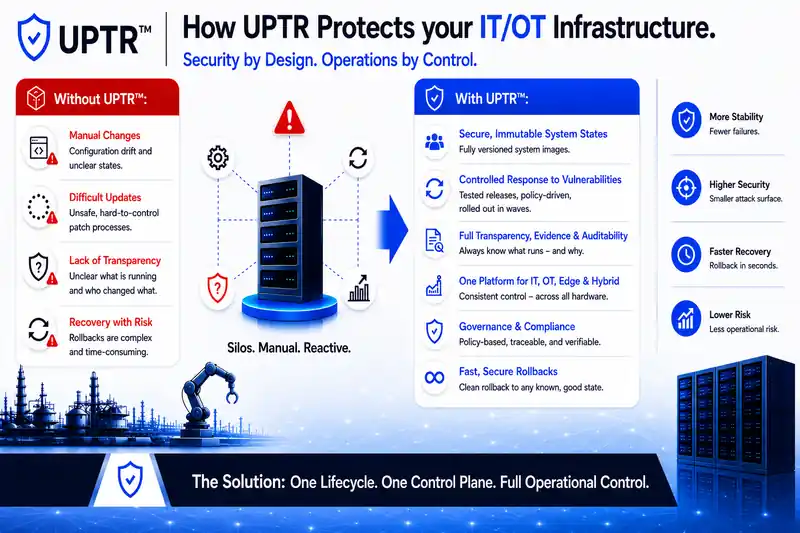
Operating systems and services must remain stable throughout daily operations. Operational challenges typically include:
🔹 Monitoring infrastructure health
🔹 Scaling workloads
🔹 Managing distributed environments
🔹 mmaintaining operational transparency
In IT/OT environments, these challenges are amplified by long hardware Lifecycles, remote locations, and strict availability requirements. Lifecycle-based operations ensure that infrastructure remains aligned with its intended state even as workloads evolve.
A modern Cyber Resilience strategy includes:
🔹 Automated rollback mechanisms
🔹 Reproducible system states
🔹 Disaster recovery procedures
🔹 Infrastructure redeployment
Instead of repairing broken systems manually, modern operational models allow systems to be recreated from a known state. This dramatically reduces recovery time and operational uncertainty.
UPTR makes cyberresilience operational by turning system security into controlled, reproducible, auditable system states - at scale, across IT, OT and Edge.
1. Secure, Immutable System States
➜ Build fully versioned system images
➜ Eliminate configuration drift and ‘snowflake systems’
➜ Ensure every system runs a known, approved state
✔️ No unknown changes
✔️ No hidden deviations
✔️ Full consistency across fleets
2. Controlled Response to Vulnerabilities
When a critical CVE or zero-day appears:
➜ A new patched system state is built
➜ It is tested and validated (boot, services, security checks)
➜ It is approved via policy (DEV → STAGE → PROD)
➜ It is rolled out in controlled waves (rings, sites, criticality levels)
If needed: clean rollback to a known-good state
✔️ Fast, safe incident response
✔️ No risky manual patching
✔️ No uncontrolled mass updates
3. Full Visibility, Proof and Auditability
At any time, you can answer:
➜ Which systems are already patched?
➜ Which are still running older versions?
➜ Which version runs where?
➜ Who approved what and when?
➜ What exactly changed compared to before?
✔️ Audit-ready documentation
✔️ Forensics-capable traceability
✔️ Compliance support (ISO, NIS2, KRITIS, etc.)
4. One Platform for IT, OT, Edge and Hybrid
UPTR secures:
➜ Industrial IT & OT environments
➜ KRITIS operators (energy, water, traffic, industry, control centers)
➜ Edge, retail and branch networks
➜ Data centers and hybrid cloud infrastructures
Always with the same principle:
Build ➜ Approve ➜ Deploy ➜ Verify ➜ Prove ➜ Roll back
The Security Value of UPTR:
✔️ Controlled, immutable system states
✔️ No configuration drift
✔️ Fast and safe response to security incidents
✔️ Reproducibility and auditability
✔️ Clean, reliable rollbacks
✔️ Proven compliance
✔️ Fewer human errors in critical operations
Reduce cyber risk through controlled system states
Security cannot be maintained through isolated tools and reactive processes alone.
UPTR establishes Lifecycle-driven control across Provisioning, Configuration, Updates, Governance and Decommsissioning - reducing attack surfaces while enabling traceable and audit-ready IT/OT operations.