Controlled Kubernetes
Kubernetes provides a strong foundation for modern industrial platforms - but controlled operations across distributed IT/OT environments require more than container orchestration alone.
UPTR extends Kubernetes with Lifecycle Control, Governance and reproducible operational processes for stable, auditable and controlled operations.
Control Gaps Across the Stack
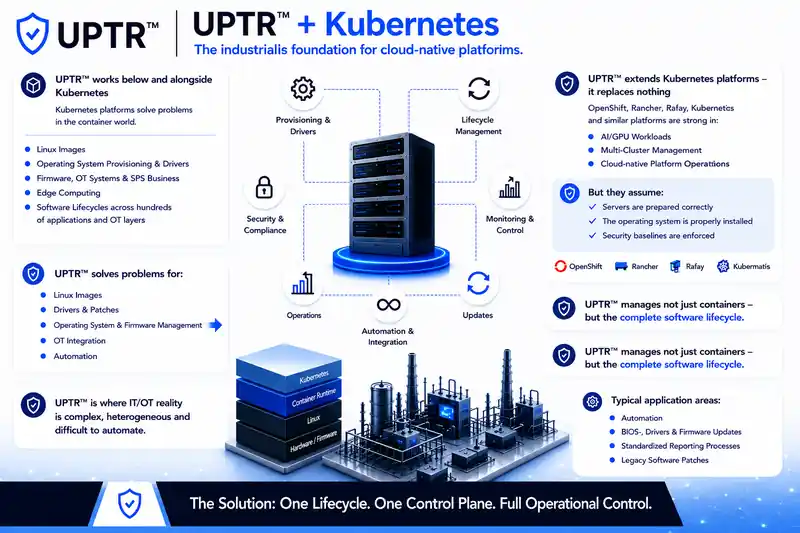
Kubernetes orchestrates container-based applications and ensures that modern software runs reliably across distributed, dynamic and scalable environments.
It solves key challenges of modern IT and OT infrastructures: applications are distributed across containers, systems span data centers, clouds and edge locations, updates are performed without downtime and workloads scale automatically.
But Kubernetes starts where infrastructure already exists. It assumes provisioned systems, defined identities, consistent configurations and controlled system states.
In real IT/OT environments, this assumption does not hold. Infrastructure is heterogeneous, distributed and long-running — spanning physical systems, edge devices, legacy components and cloud-native platforms.
This creates a gap between orchestration and actual system control.
UPTR closes this gap.
It establishes and enforces control across the underlying infrastructure before, alongside and independently of Kubernetes. From provisioning and configuration to updates, governance and lifecycle management, UPTR ensures that the systems Kubernetes depends on are defined, controlled and operational at scale.
UPTR: The missing layer between classic Infrastructure, OT, Edge and the Container/AI world
1. Kubernetes platforms only solve problems within the container world
UPTR solves the problems for:
➜ Linux images, drivers, firmware
➜ OT systems, PLC-related edge computing
➜ Software lifecycle across hundreds of applications
➜ Standardization across locations
➜ Deployment without cloud / containers / internet
👉 UPTR is designed for companies with highly regulated, heterogeneous and mission-critical environments – not just cloud/container top layers.
2. UPTR complements Kubernetes platforms instead of replacing them
OpenShift and similar platforms excel at:
➜ AI/GPU workloads
➜ Multi-cluster management
➜ Cloud-native platform operation
⚠️ BUT they require that:
➜ the servers are properly provisioned
➜ the OS is correctly installed
➜ security policies are running in a standardized manner
➜ the runtime is compatible
➜ firmware/drivers are up to date
➜ edge hardware operates reliably
👉 UPTR automates precisely this – and makes Kubernetes possible in industrial environments in the first place. UPTR automates the foundation on which Rafay, OpenShift, Rancher or Kubermatic operate.
3. UPTR is optimized for IT/OT environments – no cloud-first mindset
Kubernetes platforms are built for cloud, data centers and software teams.
UPTR is ideal for:
➜ Logistics centers
➜ Manufacturing
➜ Energy & Critical Infrastructure
➜ Transportation & Mobility
➜ Edge locations
➜ Plants with 500–10,000 physical nodes
➜ Mixed generations of hardware & systems
👉 UPTR excels where IT/OT reality is complex, disorganized, and difficult to automate.
4. UPTR manages not just containers, but the entire software Lifecycle
From firmware ➜ OS ➜ base stack ➜ middleware ➜ application
Other platforms manage: clusters, deployments, containers, GPUs
UPTR also manages:
➜ System installations
➜ Updates / Patching / Dependencies
➜ Drivers / Firmware
➜ Configuration drift
➜ OT edge rollouts
➜ Mass deployment
➜ Legacy software packages
👉 UPTR is the infrastructure and software Lifecycle Control Plane for industry and critical infrastructure (KRITIS).
Orchestration Meets Infrastructure Control
1. Layer: Physical Infrastructure (IT + OT)
UPTR handles:
➜ Servers
➜ Edge Devices
➜ Industrial PCs
➜ Controllers, IoT/OT Components
➜ Networks, Storage
➜ Firmware, BIOS, Drivers
✔️ This area is fully automated and standardized by UPTR.
2. Layer: System Infrastructure
UPTR handles:
➜ OS Installation & Imaging
➜ Firmware & Driver Management
➜ Baseline Software & Runtime Stacks
➜ Configuration & Compliance
➜ Rollouts & Updates
➜ Lifecycle Management
➜ Infrastructure Standardization Across Sites
✔️ UPTR provides the stable, secure, and auditable foundation upon which Kubernetes can reliably run – especially in IT/OT environments.
3. Layer: Container Orchestration
Kubernetes handles:
➜ Container Orchestration
➜ AI/ML Workloads (GPU/CPU Scheduling)
➜ Microservices
➜ Deployment, Scaling, Self-Healing
➜ Application Isolation & Service Mesh
✔️ Kubernetes leverages a clean, standardized infrastructure that UPTR automatically deploys and maintains.
4. Layer: Application & Services
UPTR and Kubernetes handle:
➜ AI/ML Models
➜ Logistics & Industrial Applications
➜ SCADA Microservices
➜ OT Gateways (MQTT, OPC UA)
➜ Business Apps
➜ Edge Inference & Data Processing
➜ Monitoring/Security Tools
✔️ All applications benefit directly from UPTR and Kubernetes because the environment is stable, scalable and secure.
Extend Kubernetes with Lifecycle-driven infrastructure control
Kubernetes orchestrates modern applications and containerized workloads.
UPTR extends this model as Control Plane across the underlying IT/OT infrastructure - enabling controlled provisioning, reproducible system states, lifecycle governance and traceable operations from BIOS to Kubernetes.