Why immutable infrastructure reduces operational drift
UPTR enables controlled and reproducible change across the entire Lifecycle of Immutable Infrastructure environments.
By continuously aligning systems to defined and approved states, organizations gain predictable operations, controlled updates and full operational traceability.
Immutable Infrastructure: Foundation for Controlled Lifecycle
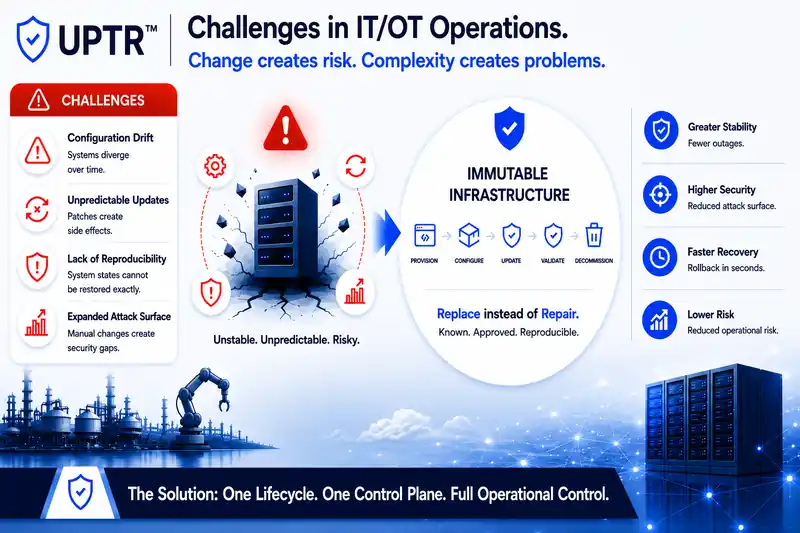
In modern IT and OT environments, any change to a running infrastructure quickly becomes a risk. Manual adjustments, unplanned updates, or inconsistent configurations often lead to system drift, errors that are difficult to reproduce, and long recovery times. Especially in industrial and critical environments (KRITIS), even small changes to the system state can cause significant operational disruption.
Immutable Infrastructure addresses this at its root: it establishes a defined, reproducible system state as the basis for all Lifecycle operations.
It becomes the foundation for a controlled Lifecycle with:
➜ automated Provisioning
➜ consistent Configuration Management
➜ controlled Update and Patch Processes
➜ Governance & Compliance by Design
➜ secure Decommissioning
UPTR makes this operational. From operating System Provisioning and Configuration to the Update Lifecycle, a fully reproducible infrastructure pipeline is established. Systems are deployed as defined states, updated in a controlled manner and can be reverted instantly if required.
The result is not infrastructure that is controlled over time but infrastructure that is controlled from the start.
From Mutable Systems to Controlled States
Traditional, mutable systems introduce structural instability over time. Configuration drift, unpredictable updates and manual changes lead to inconsistent system states that are difficult to reproduce and control. In complex IT/OT environments, these inconsistencies increase operational risk and expand the attack surface.
Immutable Infrastructure addresses this by eliminating in-place changes. Systems are no longer modified while running - they are replaced as fully defined, versioned system states. Every change is deployed as a new, tested and reproducible system image. Infrastructure becomes a controlled state that can be deployed, verified and rolled back at any time.
This shifts infrastructure from mutable systems to controlled system states:
✔ no uncontrolled change
✔ Replace instead of Repair
✔ defined and versioned system states
✔ predictable and repeatable deployments
The result is not a historically grown system but a defined, controlled and reproducible system state.
Immutable Infrastructure defines the model - but it does not establish operational control by itself.
From Immutable Infrastructure to State Control with UPTR
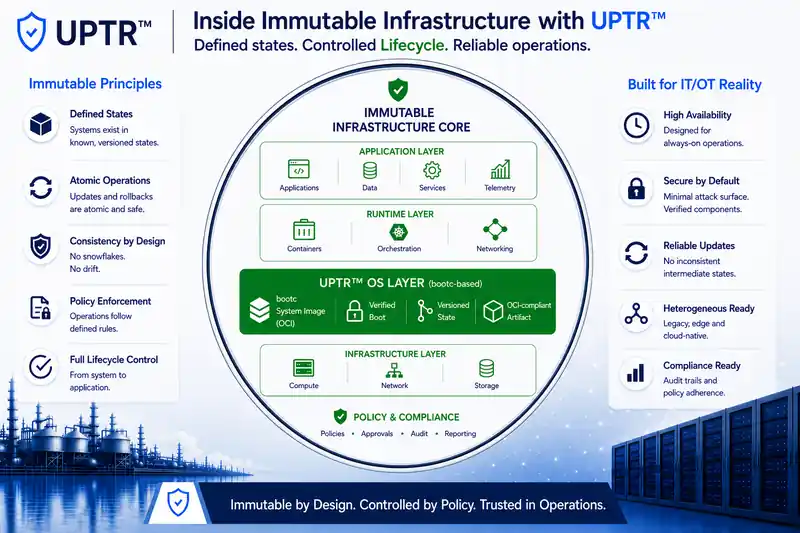
In IT/OT environments, additional requirements arise for evolving infrastructures: long-running systems, high availability demands, regulatory constraints and the combination of legacy and cloud-native components.
These environments require more than immutable system images. System states must be consistently defined, enforced and orchestrated across the entire Lifecycle - from Provisioning to Decommissioning.
Immutable Infrastructure shifts the focus from change to defined system state:
✔ Updates without uncontrolled side effects
✔ Standardized rollbacks to known states
✔ Clear separation between development, testing and operations
✔ Reduced operational risk in running systems
UPTR operationalizes this model through Control Plane:
➜ bootc-based system images as versioned, OCI-compliant states
➜ end-to-end Lifecycle control from system level to application
➜ atomic updates and reliable rollbacks without inconsistent intermediate states
➜ policy-driven operations based on defined target states
➜ stable operation in distributed, critical and regulated environments
Immutable Infrastructure replaces traditional change processes with a different principle: it is not the change that is controlled - but the target state that is defined and enforced.
The result is not a reactive operating model but a controlled, auditable and reproducible system state across the entire Lifecycle.
Establish control - before complexity becomes operational risk
Immutable Infrastructure establishes a controlled operating model where systems are no longer manually modified in production. Instead of repairing environments over time, infrastructure is replaced through versioned and reproducible system states.
UPTR extends this principle across the entire IT/OT Lifecycle enabling controlled updates, reduced operational risk and audit-ready operations across distributed environments.
Validate how UPTR can transform uncontrolled infrastructure into predictable, Lifecycle-driven operations.