How to Maintain Consistency Across IT/OT Environments
Distributed infrastructures slowly lose consistency as environments evolve differently across edge, cloud and data center operations.
UPTR enforces synchronized system states and centralized Lifecycle control across distributed environments.
Why Consistency Across Environments Becomes Difficult
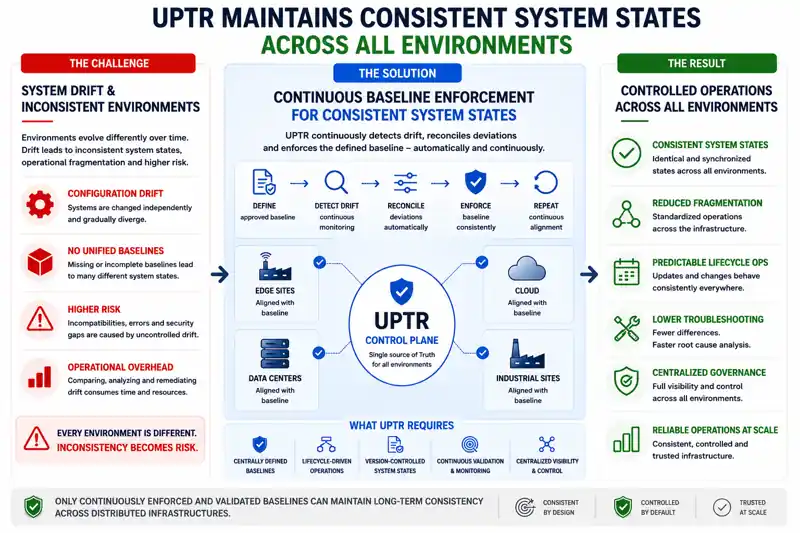
Distributed infrastructures continuously evolve across edge, cloud and data center environments.
Different update cycles, local operational changes, hardware variations and isolated deployment processes gradually create inconsistent infrastructure states across sites and operational domains.
The larger environments become, the harder it gets to maintain synchronized system states, predictable Lifecycle operations and centralized operational control manually. Maintaining long-term consistency across distributed infrastructures therefore requires far more than automation alone.
Organizations need centrally defined infrastructure baselines, lifecycle-driven operations, version-controlled system states, continuous validation of desired states and synchronized update and deployment processes across all environments. This also changes operational responsibility.
Infrastructure teams can no longer manage systems as isolated environments. Operations increasingly become state-driven, Lifecycle-oriented and continuously validated across the entire infrastructure landscape.
Without continuously enforced baselines, distributed infrastructures slowly drift apart operationally.
How UPTR Enforces Consistent System States
UPTR continuously enforces centrally defined infrastructure baselines across edge, cloud and data center environments.
The UPTR Control Plane validates desired system states continuously and automatically detects operational deviations before inconsistencies spread across the infrastructure.
Instead of managing environments independently, UPTR establishes lifecycle-driven consistency across the entire operational landscape.
At the same time, centralized visibility, traceability and operational control remain maintained across distributed infrastructures, enabling predictable operations at scale.
This helps organizations maintain synchronized system states, standardize lifecycle operations and reduce operational fragmentation across distributed environments.
Why Centralized Lifecycle Control Also Requires Governance
Centralized Lifecycle control creates significant operational advantages, but it also introduces new responsibilities.
The more infrastructure becomes automated and centrally orchestrated, the more important governance, validation and operational visibility become.
Incorrect baselines, uncontrolled automation or missing validation mechanisms can propagate operational problems quickly across distributed environments.
This is why controlled infrastructure operations require more than automation alone.
They require continuously validated system states, traceable Lifecycle changes and centralized operational control throughout the entire infrastructure Lifecycle.
Result: Controlled Operations Across All Environments
Organizations maintain consistent system states across edge, cloud and data center environments while reducing operational fragmentation and troubleshooting complexity.
Lifecycle operations become more predictable, infrastructure governance remains centrally controlled and distributed environments stay operationally aligned over time.
Only continuously enforced and continuously validated baselines can maintain long-term consistency across distributed infrastructures.
Maintain Control Across Distributed Infrastructure
Distributed infrastructures drift apart continuously.
Without enforced baselines, operational consistency eventually becomes impossible to maintain.
UPTR continuously validates infrastructure states across edge, cloud and data center environments to maintain synchronized and controlled operations at scale.